Case Studies
Decoupling the Hardware Critical Path: How Lean Physical AI Teams Multiply Engineering Throughput
Physical AI teams don't always have a hardware problem. They have a productivity problem created by hardware. How decoupling software development from physical hardware multiplies engineering throughput for lean robotics teams.
15 min read
On this page (19 sections)
- 1. The Lean-Team Constraint
- 2. Hardware Becomes the Software Critical Path
- 3. Bad Data Can Be More Expensive Than Bad Models
- 4. Put Data Quality Before Expensive Training
- 5. Separate Physical Reality From Software Velocity
- 6. Simulation Should Be an Engineering Environment, Not Just a Visualization
- 7. From Simulation to Automated Evaluation
- 8. Make the Robot Development Loop More Like Software Development
- 9. The Next Step: Let AI Agents Participate in the Engineering Loop
- 10. The Evaluation Harness Is the Test Suite for the Robot
- 11. Frozen Evaluation Contracts
- 12. Separate Development Feedback From Final Evaluation
- 13. What This Changes for a Lean Robotics Team
- 14. The Hardware Loop and the Software Loop
- 15. What Tarfy Builds
- 16. The Broader Engineering Principle
- 17. The Result: More Engineering Throughput Without More Hardware
- 18. The Tarfy Advantage
- Is Your Robot Becoming Your Software Team’s Bottleneck?
- Project
- Humanoid Manipulation Workflow & Telemetry Infrastructure
- Role
- Physical AI Infrastructure & Autonomous Evaluation Harness Design
- Period
- 2026
- Technologies
- NVIDIA IsaacLab-Arena, OpenUSD, Unitree G1, Vision-Language-Action Models, Signal Processing, Automated Evaluation Harness
Outcome summary
- Decoupled software iteration from hardware availability, enabling continuous offline simulation and evaluation.
- Detected trajectory jitter, operator drift, and teleoperation anomalies before expensive GPU model training.
- Deployed reproducible OpenUSD simulation environments and frozen evaluation contracts for automated policy benchmarking.
- Enabled controlled agentic iteration loops with blind evaluation suites preventing reward hacking.
Physical AI teams don’t always have a hardware problem. They have a productivity problem created by hardware.
Physical robots are expensive, scarce, imperfect, subject to continuous maintenance, and difficult to operate around the clock. When an engineering workflow is tightly coupled to physical hardware availability, software iteration speed grinds to a halt every time a robot is recalibrated, repaired, or physically reconfigured.
This creates a fundamental bottleneck for modern robotics organizations:
How can a lean Physical AI team dramatically increase its engineering throughput without proportionally increasing hardware, compute, or headcount?
The answer is structural:
Decouple software development from the physical hardware critical path.
By separating physical demonstration capture from offline data diagnostics, simulation, policy evaluation, and software experimentation, robotics teams can continue engineering while hardware is offline, detect problematic teleoperation data before expensive GPU training runs, run reproducible simulation experiments, and maximize the value of scarce physical robot access.
This case study describes how that approach can be applied to a high-degree-of-freedom humanoid manipulation workflow—and why the same architecture can help lean robotics teams move faster without simply adding more engineers or more hardware.
1. The Lean-Team Constraint
Building production Physical AI requires solving challenges across multiple disciplines simultaneously:
- Hardware integration and sensor calibration
- Teleoperation and demonstration collection
- Simulation environment development
- Dataset hygiene and signal processing
- Policy training and foundation-model fine-tuning
- Infrastructure orchestration
- Evaluation harness design
- Real-world safety verification
- Edge deployment
In a large robotics organization, these responsibilities can be divided across dedicated hardware, controls, simulation, ML, infrastructure, and data teams.
Lean teams don’t have that luxury.
The same engineers may move between robot calibration in the morning, teleoperation data collection in the afternoon, simulation debugging later that day, and model evaluation at night.
That creates a problem that is easy to underestimate:
Every dependency between these activities becomes a potential productivity bottleneck.
If the robot is unavailable, simulation work may stop.
If the dataset is questionable, model training becomes questionable.
If the simulation environment is difficult to reproduce, every experiment becomes slower.
If evaluation is manual, engineers cannot run enough experiments to meaningfully explore the policy space.
This means that adding headcount is not always the most effective way to increase output.
More people operating inside a tightly coupled system can simply create more coordination, more handoffs, and more dependencies.
For lean Physical AI teams, engineering architecture becomes a productivity multiplier.
The objective is not merely to build better robotics software.
It is to build a development system in which each engineer can produce more validated engineering progress per unit of time.
2. Hardware Becomes the Software Critical Path
A physical robot—especially a high-degree-of-freedom humanoid—is not an infinitely available software development environment.
Physical systems introduce constraints that conventional software teams rarely face:
- Actuator thermal limits
- Mechanical wear
- Encoder calibration drift
- Communication jitter
- Sensor failures
- Battery and power constraints
- Dexterous hand wear
- Mechanical collisions
- Physical reconfiguration
- Safety requirements
- Maintenance and repair
These are not edge cases.
They are inherent characteristics of developing embodied systems.
The problem occurs when software development becomes directly dependent on resolving these physical issues.
Imagine a team developing a new manipulation policy.
An engineer makes a change.
To determine whether it works, the team needs the robot.
But the robot is currently being recalibrated.
The team waits.
Once the robot becomes available, another team needs it for data collection.
The experiment is delayed again.
Eventually the robot is available, but the environment has changed, the operator has changed, or the physical setup is slightly different.
Now the experiment itself may not be reproducible.
The result is a development loop governed by physical scheduling rather than software iteration.
The problem isn’t that the robot is unavailable. The problem is that too much of the engineering workflow depends on the robot being available.
When the physical hardware becomes the critical path for everyday software decisions, team velocity drops to the speed of physical maintenance.
The architectural alternative
Not every engineering question requires a physical robot.
Many questions can be answered offline:
- Did the policy improve?
- Did a controller change introduce a regression?
- Did a dataset become statistically inconsistent?
- Did a trajectory contain excessive jitter?
- Did a new recovery strategy improve simulated task completion?
- Did a code change alter previously validated behavior?
- Does a policy fail consistently under a particular scenario?
- Does a new model outperform the previous baseline?
These are software engineering questions.
They should be answered with software whenever possible.
That leads to a simple principle:
Don’t use a physical robot to answer a question that can be answered in software.
3. Bad Data Can Be More Expensive Than Bad Models
Modern Physical AI increasingly relies on imitation learning, teleoperation datasets, and Vision-Language-Action models.
This creates another dependency.
A policy can only be as good as the data used to train and evaluate it.
Yet teleoperation data is often treated as if it were a clean, stationary signal.
Human operators are not stationary controllers.
Over multi-session or multi-hour recording workflows, demonstrations can naturally change.
For example:
- Movement velocities can drift as operators become fatigued.
- Grasp and release timing can change.
- Operators may introduce additional corrective motions.
- Trajectories can contain micro-hesitations.
- Posture selection can vary between sessions.
- Sensor and communication latency can introduce jitter.
- Different recording batches can have different statistical characteristics.
None of these automatically means a dataset is unusable.
The problem is that the team needs to know when the characteristics of the data have changed before using that data to draw expensive conclusions.
Otherwise, the development loop becomes:
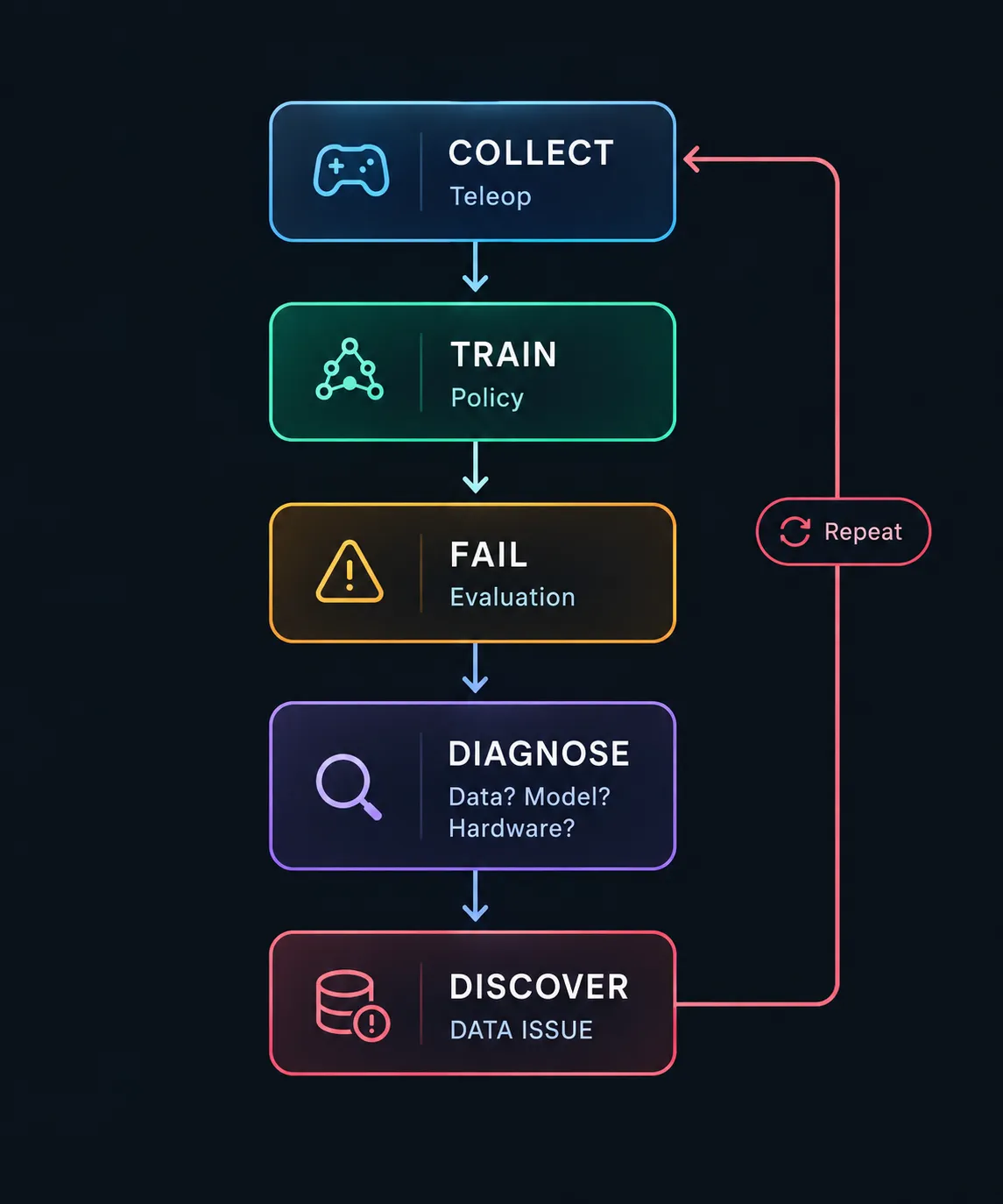
That loop is expensive because the problem is discovered downstream.
A better architecture moves diagnostics upstream.
4. Put Data Quality Before Expensive Training
The solution is to treat robotics telemetry as an engineering artifact that should be tested before it enters downstream workflows.
Instead of asking only:
“Can we train a policy on this dataset?”
ask:
“Does this dataset satisfy the invariants we expect from a usable training signal?”
For this workflow, the diagnostic layer can examine properties such as:
Temporal stability
Are joint trajectories behaving consistently over time?
Velocity and acceleration behavior
Are there unusual second-difference patterns that may indicate jitter, discontinuities, or unstable motion?
Cross-session consistency
Do different recording batches exhibit statistically significant differences?
Operator drift
Are changes in trajectories potentially associated with changes in operator behavior rather than changes in the underlying task?
Actuator behavior
Are there recurring patterns that may indicate resonance, communication artifacts, or other hardware-related anomalies?
The implementation used complementary statistical approaches, including:
- Augmented Dickey-Fuller testing
- KPSS stationarity testing
- Second-difference trajectory analysis
- Kruskal-Wallis non-parametric comparisons
The important point is not the individual statistical tests.
The important point is the workflow they enable:
Detect questionable data before it consumes expensive downstream engineering resources.
Problematic recordings can be flagged or quarantined rather than silently becoming part of the training corpus.
That changes the economics of iteration.
Instead of spending compute to discover a data problem later, the team can identify the problem at the point where it enters the pipeline.
5. Separate Physical Reality From Software Velocity
The resulting architecture can be thought of as two connected engineering tracks.
Track 1: Physical Reality
The physical system is responsible for information that can only come from the real world:
- Teleoperation
- Demonstration capture
- Real sensor behavior
- Real actuator behavior
- Hardware calibration
- Physical contact
- Real-world task execution
- Multimodal telemetry
This is where reality enters the system.
The physical robot remains essential.
But it no longer needs to be involved in every downstream engineering decision.
Track 2: Software Velocity
Once data leaves the physical system, as much engineering as possible moves offline:
- Dataset validation
- Telemetry diagnostics
- Simulation
- Policy evaluation
- Failure analysis
- Experimentation
- Regression testing
- Model comparison
This track can run independently of physical hardware availability.
The architecture therefore looks like:
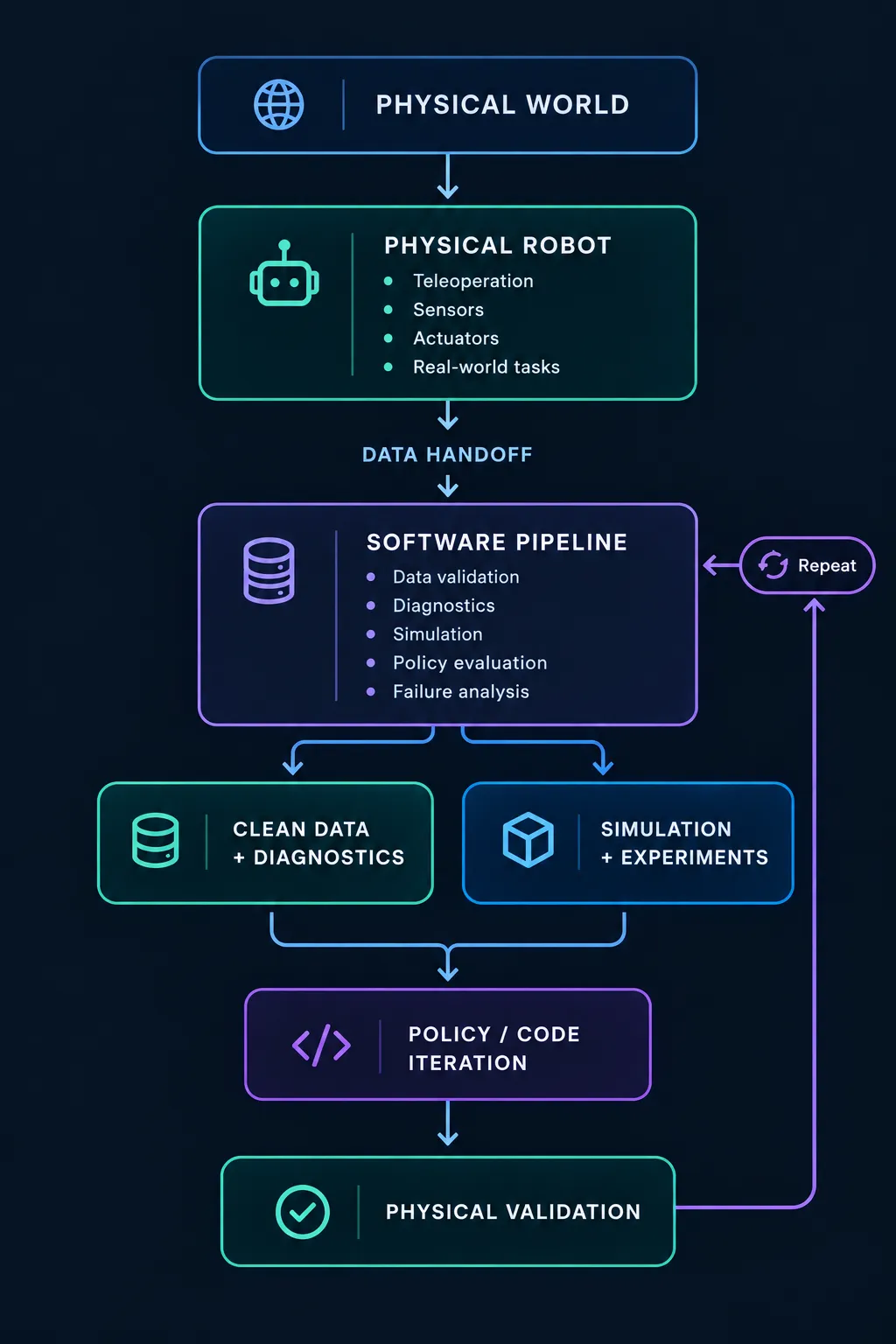
The physical robot becomes the source of truth for reality.
It no longer needs to be the bottleneck for every engineering decision.
6. Simulation Should Be an Engineering Environment, Not Just a Visualization
Simulation is often discussed as a way to approximate reality.
For engineering teams, its more important role is different:
Simulation creates a repeatable environment in which software can be tested.
A useful robotics simulation environment should allow engineers to answer the same question repeatedly under controlled conditions.
That requires more than a realistic scene.
It requires:
- Reproducible environments
- Explicit task definitions
- Versioned assets
- Deterministic or controlled evaluation conditions
- Consistent metrics
- Automated execution
- Structured failure reporting
For this workflow, NVIDIA IsaacLab-Arena and OpenUSD-based scene organization were used to create a modular simulation environment around a high-degree-of-freedom humanoid manipulation task.
The implementation included a Unitree G1 configuration with dexterous hands and a task environment for controlled manipulation.
Rather than treating the simulation as a single monolithic environment, the workflow separated the components needed to reproduce and evaluate experiments.
That distinction matters.
A simulation environment that can only be launched manually is useful for demonstrations.
A simulation environment that can be executed automatically, repeatedly, and consistently becomes engineering infrastructure.
7. From Simulation to Automated Evaluation
Once simulation becomes reproducible, another opportunity appears.
Instead of asking an engineer to watch every experiment, the system can evaluate the outcome automatically.
This changes the development loop from:
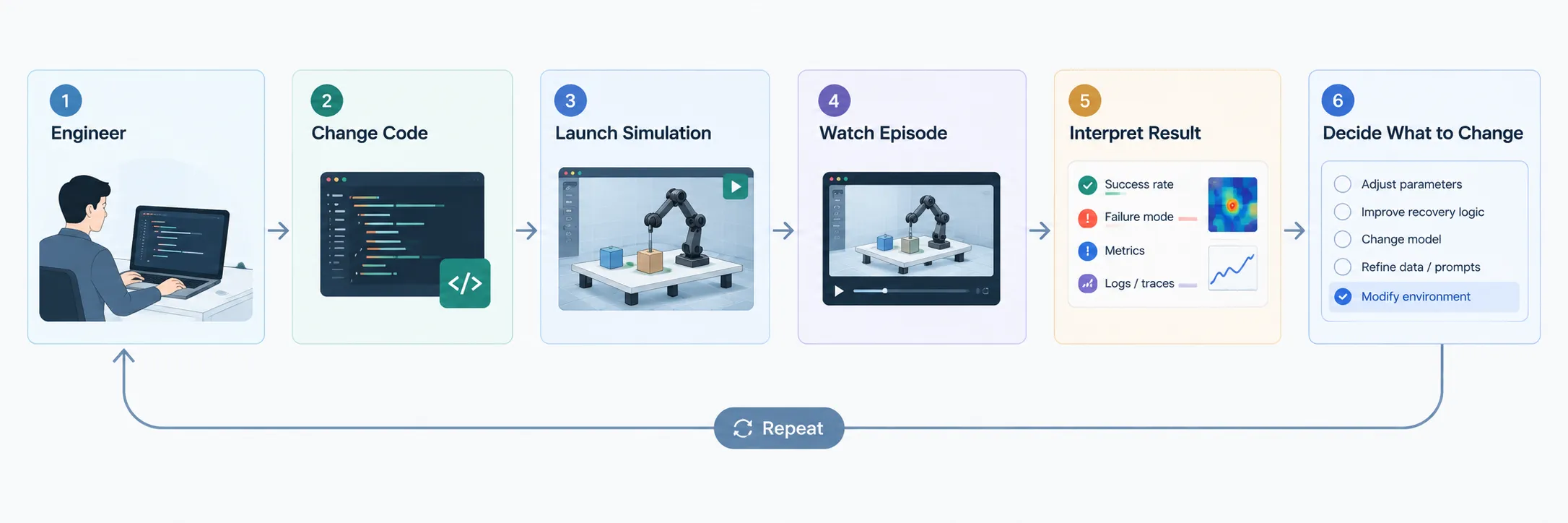
to:
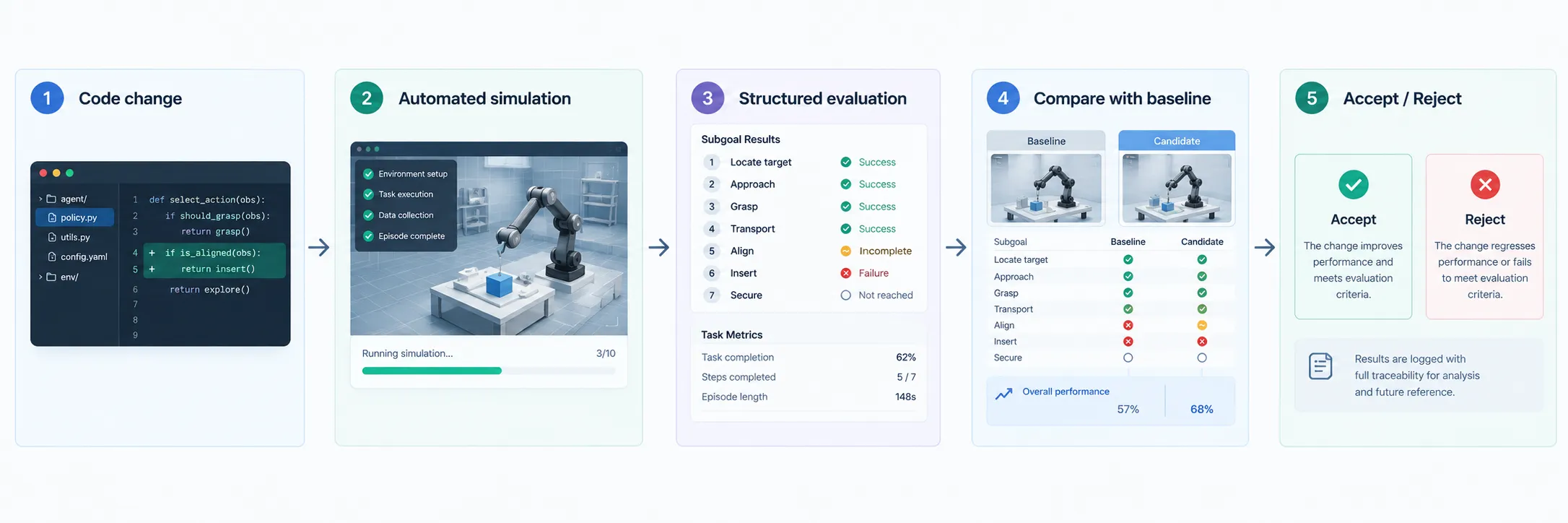
That is a fundamental shift.
The goal is not to remove engineers from robotics.
The goal is to remove engineers from repetitive evaluation work that software can perform more reliably.
Once the evaluation layer is trustworthy, the team can begin running substantially more experiments without requiring proportional increases in human attention.
8. Make the Robot Development Loop More Like Software Development
This is where the architecture starts to resemble modern software engineering.
A mature software team does not manually inspect every application after every code change.
It relies on automated infrastructure:
- Unit tests
- Integration tests
- Regression tests
- Continuous integration
- Version control
- Automated builds
- Deployment checks
Robotics needs analogous infrastructure.
A robot policy, controller, planner, or workflow should be treated as software that can be:
- Modified
- Tested
- Evaluated
- Compared against a baseline
- Accepted or rejected
- Repeated
The physical robot is still required for final validation.
But the number of changes that reach the physical robot can be dramatically reduced.
Instead of:
Every experiment → physical robot
the workflow becomes:
Many experiments → simulation → best candidates → physical validation
This is one of the most important opportunities for increasing robotics engineering throughput.
9. The Next Step: Let AI Agents Participate in the Engineering Loop
Once the robotics development workflow becomes reproducible and machine-evaluable, another possibility becomes practical:
AI agents can participate in the development loop.
An agent does not need to control the physical robot directly to be useful.
It can operate on the software layer.
A controlled development loop can look like:
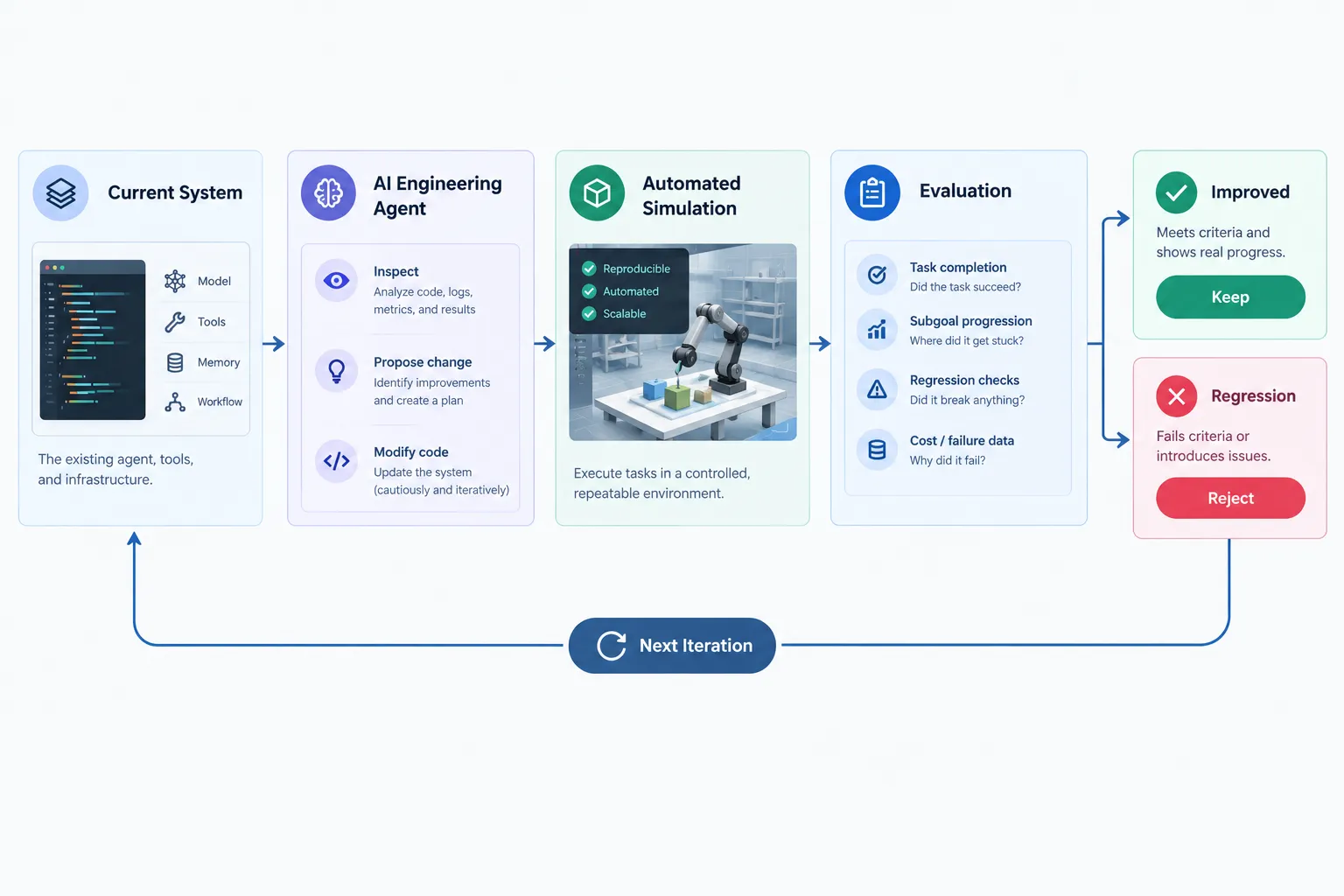
This is where agentic AI becomes interesting for robotics.
The value is not simply:
“An AI can write robot code.”
The more important idea is:
An AI agent can perform engineering experiments at a scale and frequency that would be impractical for a human engineer to execute manually.
The human engineer remains responsible for architecture, constraints, system design, and final validation.
The agent becomes an additional source of engineering throughput.
10. The Evaluation Harness Is the Test Suite for the Robot
There is one major problem with this approach.
If an AI agent is told:
“Improve the score.”
it may find a way to improve the score without actually improving the underlying system.
This is the robotics equivalent of reward hacking.
For example, an agent could potentially modify:
- collision tolerances
- success thresholds
- recovery conditions
- filtering parameters
- evaluation assumptions
and produce a better metric without producing a genuinely better policy.
That makes the evaluation infrastructure itself a critical engineering component.
The system being optimized should not be able to freely redefine the rules by which it is judged.
This leads to an important principle:
The evaluation system must be harder to manipulate than the software being evaluated.
11. Frozen Evaluation Contracts
The architecture therefore separates the software being changed from the criteria used to evaluate it.
The task can be decomposed into explicit subgoals.
For a precision manipulation workflow, those stages might include:
- Identify the target
- Approach the component
- Establish a grasp
- Transport the component
- Align the interface
- Complete insertion
- Secure the component
- Complete auxiliary connections
The exact task is less important than the principle.
Each stage becomes a measurable condition.
Instead of receiving only:
Success = 1
Failure = 0
the evaluation system can determine:
Target identified       ✓
Approach completed      ✓
Grasp established      ✓
Transport completed    ✓
Alignment failed       ✗
Insertion attempted     ✗
This provides the agent with structured information about where its proposed change helped or failed.
More importantly, the evaluation criteria remain outside the agent’s control.
12. Separate Development Feedback From Final Evaluation
A reliable automated engineering loop also needs protection against overfitting.
If the agent can repeatedly see the same evaluation scenarios, it may eventually optimize specifically for those scenarios.
That is not necessarily the same as improving the general system.
The architecture therefore separates:
Development evaluation
Feedback the agent can use to iterate.
Blind evaluation
Held-out scenarios that remain inaccessible during optimization.
This creates an analogue of a software test suite with protected regression tests.
A candidate implementation must improve against known development cases without regressing on cases it has not seen.
This distinction is essential if automated engineering agents are going to be trusted with increasingly complex robotics workflows.
13. What This Changes for a Lean Robotics Team
The real benefit of this architecture is not the simulation environment by itself.
It is the change in the team’s engineering throughput.
Without automation, a team may have:
Engineer → Experiment → Robot → ResultWith a software-driven development loop:
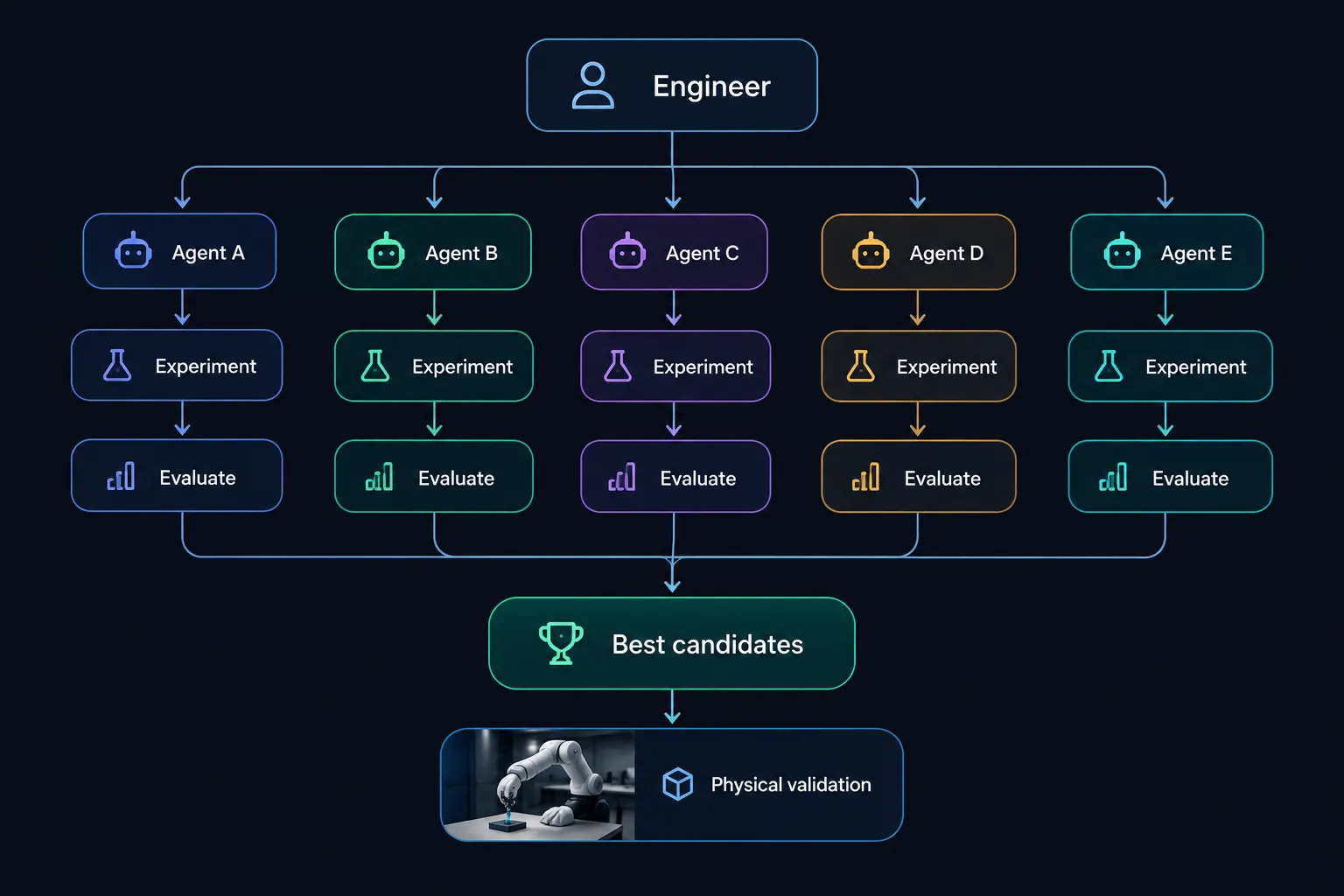
The human engineer becomes the orchestrator of engineering experiments rather than the executor of every experiment.
That is a fundamentally different scaling model.
The goal is not to replace engineers.
It is to increase the number of validated engineering iterations that a small team can produce.
14. The Hardware Loop and the Software Loop
A useful way to think about Physical AI development is as two nested loops.
The hardware loop
The physical robot determines what is actually possible in reality.
It validates:
- Contact
- Dynamics
- Sensors
- Actuators
- Safety
- Mechanical tolerances
- Real-world robustness
This loop is expensive and comparatively slow.
The software loop
Simulation and automated evaluation allow the team to explore:
- Policies
- Controllers
- Recovery strategies
- Workflow changes
- Dataset assumptions
- Failure modes
- Software architecture
This loop can be much faster.
The engineering objective is therefore not to eliminate the hardware loop.
It is to make the software loop much faster than the hardware loop.
The faster the software loop becomes, the fewer physical experiments are required to reach the next validated hardware improvement.
That is the productivity multiplier.
15. What Tarfy Builds
Tarfy helps Physical AI teams build the software infrastructure that makes this development model possible.
That can include:
- Robotics simulation infrastructure
- Teleoperation data pipelines
- Dataset validation and diagnostics
- Automated evaluation harnesses
- Regression testing for robotics
- Policy evaluation infrastructure
- Simulation-to-real workflows
- Agentic engineering loops
- Reproducible robotics environments
- Hardware/software architectural separation
The objective is not to add another layer of tooling for its own sake.
The objective is to create a development system in which engineering progress is less dependent on physical availability and less dependent on manual execution.
16. The Broader Engineering Principle
The underlying lesson extends beyond humanoids.
The same problem appears anywhere software controls a physical system:
- Industrial manipulation
- Warehouse robotics
- Autonomous mobile robots
- Drones
- Surgical robotics
- Automotive systems
- Agricultural robotics
- Industrial inspection
- Remote robotics
- Dexterous manipulation
The hardware differs.
The productivity problem is similar.
Physical systems are inherently slower to iterate than software.
The engineering opportunity is therefore to push as much of the development lifecycle as possible into reproducible software infrastructure.
The result is a simple hierarchy:
Physical hardware provides reality.
Simulation provides scale.
Automated evaluation provides feedback.
AI agents provide additional iteration capacity.
Engineers provide judgment and system architecture.
That is the foundation of a scalable Physical AI engineering workflow.
17. The Result: More Engineering Throughput Without More Hardware
The work established a development architecture capable of separating hardware-dependent activities from software-dependent iteration.
The resulting workflow provided:
Hardware-independent iteration
Simulation and software evaluation can continue while physical hardware is unavailable for maintenance, calibration, or other hardware work.
Earlier data-quality detection
Telemetry can be evaluated for statistical inconsistencies and anomalous behavior before entering expensive downstream training workflows.
Reproducible experimentation
Simulation environments and task definitions can be executed repeatedly under controlled conditions.
Automated evaluation
Candidate software changes can be evaluated consistently rather than relying entirely on manual inspection.
Controlled agentic iteration
AI agents can participate in software experimentation while remaining constrained by fixed evaluation criteria and regression checks.
Greater leverage per engineer
Most importantly, the workflow increases the amount of engineering work that can happen without requiring direct access to the physical robot.
That creates a compounding advantage:
More available engineering time → more experiments → faster feedback → faster iteration → more output per engineer.
This is the real value of decoupling the hardware critical path.
18. The Tarfy Advantage
Physical AI teams don’t necessarily need more engineers to move faster.
They often need to eliminate the dependencies that prevent their existing engineers from working at full capacity.
Tarfy’s approach is to build the engineering infrastructure between physical hardware, telemetry, simulation, evaluation, and AI-driven software development.
The goal is straightforward:
Make the development loop faster than the hardware loop.
That means turning robotics development into a workflow where:
- Data can be validated before it becomes expensive.
- Simulation can run while hardware is offline.
- Policies can be evaluated without manually watching every experiment.
- Regressions can be detected automatically.
- AI agents can perform software experiments.
- Engineers can focus on architecture, judgment, and the problems that genuinely require human expertise.
The robot still matters.
In fact, this approach makes the robot more valuable.
Instead of consuming scarce hardware time on every iteration, the team can reserve physical experiments for the questions that actually require physical reality.
The goal isn’t to replace the robot. It’s to make every hour of access to the robot more valuable.
For a lean Physical AI team, that can be the difference between scaling output by adding more people and scaling output through better engineering.
Is Your Robot Becoming Your Software Team’s Bottleneck?
Tarfy helps Physical AI and robotics teams build the software infrastructure required to move faster—from simulation and telemetry pipelines to automated evaluation and agentic engineering workflows.
Treat robotics like software wherever possible.
Make the development loop faster than the hardware loop.
Get more engineering output from the hardware and team you already have.