Blog
Beyond the Vibe: How Harness Engineering Turns AI Agents into Developer Superpowers
Why unguided 'vibe-coding' slows developers down in production codebases, and how high-leverage teams use harness engineering, deterministic verification, and declarative invariants to turn AI agents into reliable superpowers.
8 min read
On this page (6 sections)
- 1. The Realism Gap: The Cost of Unstructured “Vibe-Coding”
- 2. The LLM Productivity Cliff: Why Some Developers 10x While Others Stagnate
- 3. Case Studies in Developer Empowerment: The Patterns That Work
- 4. The Four Invariants of an Empowering Agentic Harness
- 5. Conclusion: From Vibe Coders to Harness Engineers
- References
The narrative around generative AI in software engineering is locked in a fierce, confusing contradiction.
On one side stands the intoxicating promise of “vibe-coding”—a term coined by Andrej Karpathy to describe a mode of development where syntax is abstracted away into natural language prompts, allowing founders and solo developers to summon entire web applications into existence over a weekend [1], [2]. Venture rounds for agentic IDEs and autonomous dev tools have exploded, reporting staggering adoption figures and unprecedented development velocity [3], [4].
On the other side lies a sobering body of empirical, reproducible research. In late 2025, researchers at METR conducted a rigorous randomized controlled trial with 16 experienced open-source maintainers tackling 246 real-world issues on repositories exceeding one million lines of code [5]. The result? Developers using state-of-the-art agentic tools took 19% longer to complete issues than those working completely unassisted [5].
Yet, when asked afterward, those exact same developers subjectively estimated that the AI had made them 20% faster [5], [6].
This paradox—where developers feel like they are flying while their actual delivery clock ticks backward—exposes the central challenge of the AI era: Raw large language models inside conversational chat windows do not automatically accelerate professional software engineering.
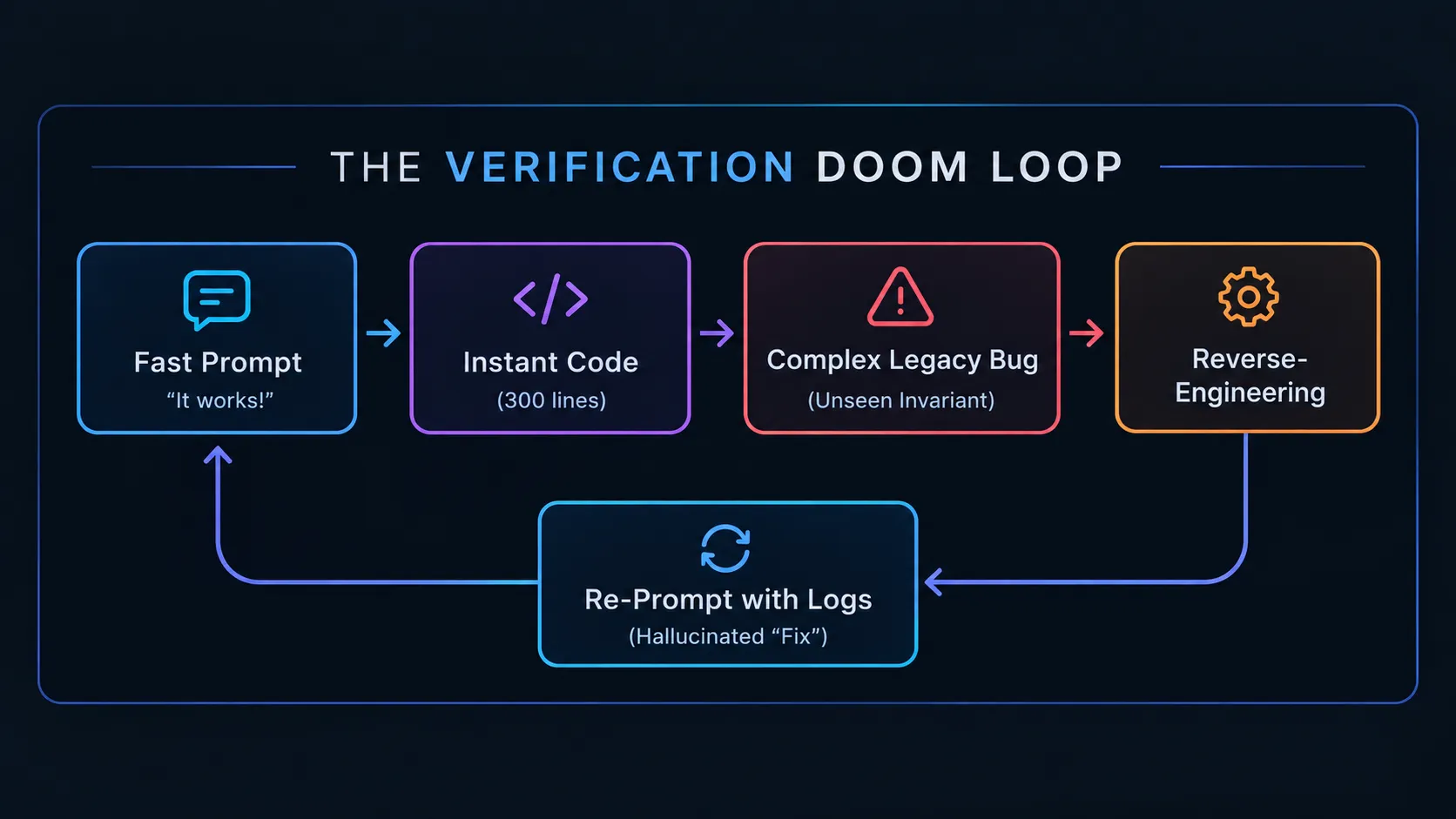
When developers treat AI as an oracle or a magic typing assistant, they fall into the verification doom loop. But when developers shift their paradigm from “prompting” to Harness Engineering, agents become extraordinary force multipliers.
Here is an evidence-based look at why agentic coding fails in unstructured environments, and the concrete architecture high-leverage engineers use to achieve genuine, compounding empowerment.
1. The Realism Gap: The Cost of Unstructured “Vibe-Coding”
To understand why unguided AI slows down experienced developers in mature codebases, consider where time is actually spent in professional software engineering.
In greenfield hackathons, the primary bottleneck is syntax generation—typing out boilerplate, routing scaffolding, and assembling standard CSS layouts. In this narrow domain, generative AI is nearly unbeatable. Studies show developers complete standardized, isolated tasks (such as building a basic HTTP server) 55.8% faster using code assistants [7].
However, in production software engineering—sprawling legacy repositories, distributed microservices, and continuous deployment pipelines—the bottleneck is never typing speed. The bottleneck is system comprehension, architectural consistency, and verifying boundary conditions.
When an unguided agent is dropped into a million-line codebase, it encounters three fundamental failure modes:
- The Bounded Attention Limit: Transformer architectures suffer from context degradation over large repositories. Research formalizes this as the Bounded Attention Prefix Oracle (BAPO) limit: attention heads lose fidelity when resolving distributed, cross-module dependencies [8]. The agent produces plausible-looking code that subtly violates invariants declared six directories away.
- The Deficit of Abductive Reasoning: Large language models are inductive pattern matchers; they excel at reproducing familiar syntax patterns [9], [10]. However, complex distributed debugging requires abductive reasoning—inferring the most likely root cause from sparse, contradictory runtime telemetry [11], [12]. Lacking an internal causal world model, an LLM defaults to token proximity, proposing superficial workarounds (e.g., adding arbitrary
try-catchblocks or restarting services) that mask underlying architectural rot. - The Cognitive Burden of Verification: Reading and mentally executing someone else’s code requires significantly more cognitive energy than writing one’s own. When an agent outputs 200 lines in five seconds, the human must meticulously audit every diff to ensure thread safety, memory boundaries, and error contracts. The developer enters the verification doom loop [5], [6], [13].
2. The LLM Productivity Cliff: Why Some Developers 10x While Others Stagnate
Why do some elite developers swear by AI agents as indispensable force multipliers, while rigorous empirical studies measure a 19% net slowdown?
Researcher Francesco Bisardi explains this divergence through the “LLM Productivity Cliff” [14].
Productivity gains from agentic AI do not follow a smooth, continuous linear curve. Instead, returns resemble a discontinuous step-function:
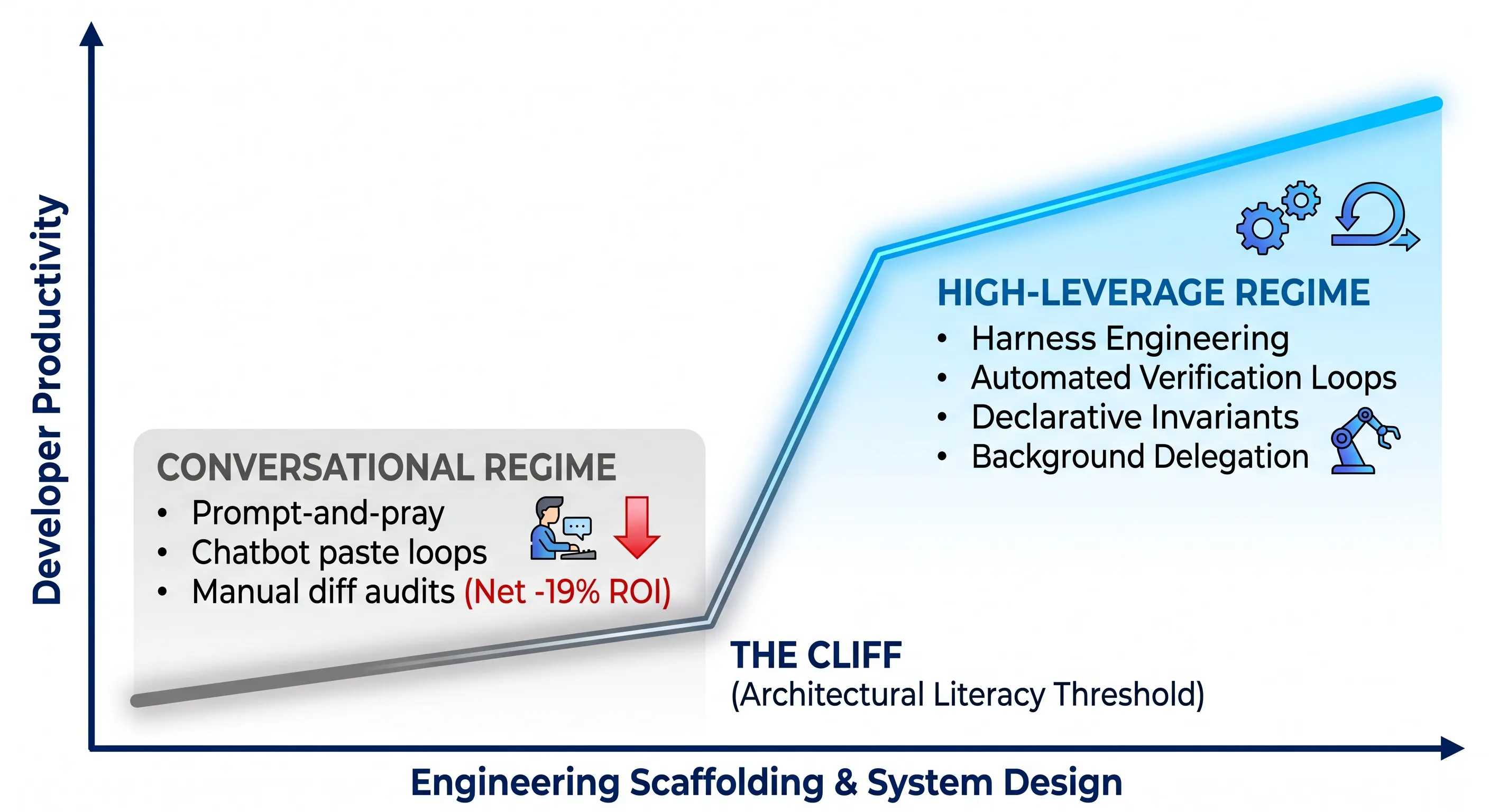
Below the Cliff: The Conversational Regime
Below the threshold, developers treat the agent as an interactive conversational partner or glorified search engine. They paste errors into a chat box, copy generated snippets into the editor, run the build manually, and argue with the model when tests fail.
In complex environments, this approach produces negative net returns. The developer incurs all the cognitive overhead of reverse-engineering non-deterministic code while remaining on the critical execution path [14].
Above the Cliff: Architectural Literacy & Harness Engineering
Above the threshold, developers fundamentally redesign their relationship with the machine. They do not write prompts; they build environments.
Crossing the cliff requires what Bisardi defines as Architectural Literacy [14]:
- The ability to systematically decompose ambiguous, multi-step goals into model-tractable, atomic specifications.
- The discipline to construct deterministic verification harnesses that catch model regressions automatically.
- The foresight to enforce strict repository invariants before the agent generates a single line of code.
3. Case Studies in Developer Empowerment: The Patterns That Work
When developers stop vibe-coding and begin engineering harnesses, the productivity gains become real, measurable, and durable.
Case 1: Mitchell Hashimoto and the “Harness Engineering” Paradigm
Mitchell Hashimoto (co-founder of HashiCorp) famously documented his transition from AI skepticism to profound leverage [15].
Initially, Hashimoto found conversational coding agents frustrating: they repeatedly misunderstood internal APIs, hallucinated obsolete package methods, and required constant human hand-holding. His breakthrough came when he treated the agent not as an intelligent colleague, but as an unreliable background worker operating inside an automated harness [15]:
- Declarative Repository Rules (
AGENTS.md/ Instructions): Instead of repeating instructions across chat prompts, Hashimoto established living configuration documents inside the repository detailing architectural standards, prohibited libraries, formatting contracts, and expected build scripts. - Automated Verification Loops: He equipped the agent with direct CLI tool access to run compilers, linters, and unit tests. If the model introduced a syntax error or broken contract, the compiler rejected the output and fed the error trace back to the agent autonomously—completely removing Mitchell from the micro-debugging loop.
- Asynchronous Background Delegation: Rather than sitting idle while watching the LLM stream tokens, Hashimoto delegated bounded tasks (such as writing comprehensive test suites or porting utility modules) to run concurrently in the background while he focused on high-level architecture.
By engineering the harness, Hashimoto successfully automated up to 20% of his daily engineering workload without compromising software reliability [15].
Case 2: Enterprise Throughput and Code Review Acceleration
Macro-level empirical data from Jellyfish Research—analyzing 20 million pull requests across 700 companies—corroborates that scaffolded agentic adoption fundamentally shifts delivery throughput [16]:
- 2.0x Pull Request Throughput: Organizations in the top tier of scaffolded agentic integration completed twice the PR volume of baseline teams [16].
- Automated Code Review Velocity: Teams utilizing agentic workflows to automate routine structural, linting, and contract review checks accelerated their review cycle times by 1.16x, handling up to 80% of routine review boilerplate without human developer fatigue [16].
- Autonomous PR Contributions: In mature implementations, autonomous agents independently authored and verified 8% of all merged pull requests, operating as continuous maintenance workers handling dependency upgrades, dead code pruning, and test coverage expansion [16].
Case 3: Cognitive Preservation & The Anthropic Skill Formation Study
A frequent concern is that agentic AI erodes developer skill formation—a phenomenon known as “cognitive offloading” [17].
In a landmark 2026 randomized controlled trial by Anthropic evaluating developers learning a complex, unfamiliar asynchronous library (Trio), researchers observed two radically different interaction archetypes [17]:
| Interaction Profile | Working Methodology | Task Speed | Conceptual Mastery Score |
|---|---|---|---|
| Blind AI Delegation | Developer treats the agent as a black box, accepting raw code without inspection. | Fast initial draft | < 40% (Severe loss of diagnostic ability) |
| Conceptual Inquiry | Developer uses the agent to explain edge cases, explore trade-offs, and generate tests, while retaining structural control. | High execution speed | > 65% (Preserved deep understanding & troubleshooting skill) |
The Anthropic study proved that AI does not inherently stunt engineering capability—unstructured delegation does [17]. When developers use agents to interrogate complex API surface areas, brainstorm alternative failure modes, and generate robust test scenarios, they achieve both high velocity and deep mastery.
4. The Four Invariants of an Empowering Agentic Harness
How can an engineering team institutionalize these breakthroughs and bypass the 19% productivity trap?
At Tarfy, our research into physical AI systems and autonomous harnesses demonstrates that developer empowerment relies on four non-negotiable architectural invariants:
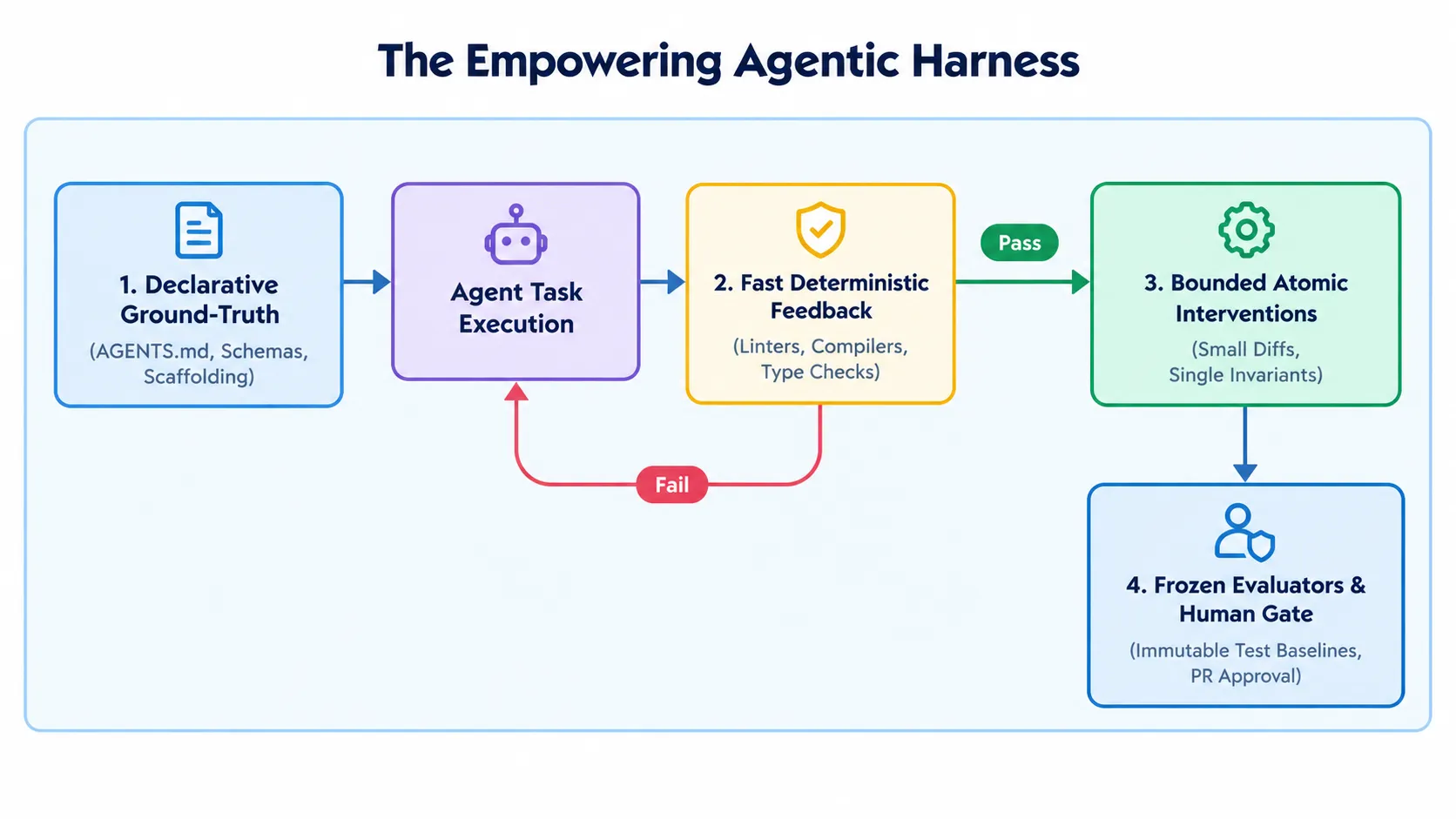
Invariant 1: Declarative Ground-Truth Context (No Prompt-and-Pray)
Never rely on the model’s conversational memory or prompt history. All critical constraints must reside on disk as declarative configuration:
- Maintain clear instruction files (
AGENTS.md,.cursorrules, or repository guidelines) detailing architectural invariants, directory boundaries, and coding standards. - Provide explicit typed schemas for data models and API boundaries so the agent does not guess JSON payloads.
# Declarative harness ground-truth (e.g., AGENTS.md)
rules:
  - "Run deterministic verification suites before presenting solutions"
  - "Preserve immutable test baselines during autonomous code edits"
Invariant 2: Fast, Deterministic Feedback Loops (System 1 Validation)
An agent must never ask a human to verify syntax or run a linter. The harness must provide immediate, programmatic feedback:
- Equip agents with tool access to execute compilers, static type checkers (e.g.,
mypy,tsc), and test runners. - The harness must automatically capture stderr/stdout and feed errors directly back to the agent for self-correction before human review.
Invariant 3: Bounded, Atomic Interventions
Never ask an agent to “refactor the entire billing subsystem.” Broad prompts trigger context degradation, hallucinated imports, and sprawling diffs.
- Keep agent tasks strictly bounded: a single bug fix, one unit test suite, or an isolated utility adapter.
- Enforce small diff budgets. If an agent generates a 1,000-line diff for a 20-line feature, reject and constrain the search space.
Invariant 4: Frozen Evaluators & Human Architectural Governance
To avoid the danger of “metric gaming” (where an agent modifies test assertions to make failing code pass), decouple the code generator from the evaluator:
- Freeze the tests: Evaluators, benchmark suites, and integration tests must remain cryptographically hashed and immutable during agentic code-editing loops.
- Retain human architectural ownership: The human engineer remains the Chief Architect—responsible for system requirements, failure analysis, and approving merges. The agent operates as a tireless, ultra-fast staff engineer executing bounded implementations.
5. Conclusion: From Vibe Coders to Harness Engineers
The software industry is not witnessing the death of software engineering. It is witnessing the death of syntax transcription.
“Vibe-coding”—blindly prompting an LLM and hoping the resulting output survives under production traffic—is a toy methodology suitable only for weekend prototypes and disposable scripts. When applied to real-world software, it generates hidden technical debt, catastrophic security gaps, and verified productivity slowdowns.
The future belongs to the Harness Engineer.
By surrounding frontier models with rigorous architectural scaffolding, deterministic verification loops, and immutable test contracts, high-leverage engineers eliminate boilerplate, automate routine maintenance, and amplify their creative throughput by an order of magnitude.
Don’t give in to the vibes. Build the harness.
References
- Cursor Team, “Vibe coding: Democratising software development,” Cursor Blog, 2026. [Online]. Available: https://cursor.co.uk/blog/vibe-coding-democratising-software-development ↩
- S. S. Kim, “How Vibe Coding Is Rewriting the Rules of Startups and Venture Capital,” Hashed Team Blog, Medium, 2026. [Online]. Available: https://medium.com/hashed-official/vibe-founders-6c15649b78d4 ↩
- K. Groszkowska, “Not just Lovable: who and how is driving the vibe coding revolution in AI economy,” Vestbee Insights, 2025. [Online]. Available: https://www.vestbee.com/insights/articles/who-and-how-is-driving-the-vibe-coding-revolution ↩
- C. Ferguson, “Vibe Coding Revolution: 5 AI-Built Apps Generating Serious Revenue in 2025,” We Are Founders, 2025. [Online]. Available: https://www.wearefounders.uk/vibe-coding-revolution-5-ai-built-apps-generating-serious-revenue-in-2025/ ↩
- J. Becker, N. Rush, E. Barnes, and D. Rein, “Measuring the impact of early-2025 AI on experienced open-source developer productivity,” METR, Tech. Rep., 2025, arXiv:2507.09089. [Online]. Available: https://metr.org/blog/2025-07-10-early-2025-ai-experienced-os-dev-study/ ↩1 ↩2 ↩3 ↩4
- Andreeco, “Paper on Perceived vs Real Productivity Gains Using LLM,” JuliaLang Discourse, 2025. [Online]. Available: https://discourse.julialang.org/t/paper-on-perceived-vs-real-productivity-gains-using-llm/133322 ↩1 ↩2
- E. Kalliamvakou, “Research: quantifying GitHub Copilot's impact on developer productivity and happiness,” The GitHub Blog, 2022. [Online]. Available: https://github.blog/news-insights/research/research-quantifying-github-copilots-impact-on-developer-productivity-and-happiness/ ↩
- T. Schnabel, K. Tomlinson, A. Swaminathan, and J. Neville, “Lost in transmission: When and why LLMs fail to reason globally,” 2025, arXiv:2505.08140. ↩
- Y. Sun and A. Saparov, “Language Models Do Not Follow Occam's Razor: A Benchmark for Inductive and Abductive Reasoning,” 2025, arXiv:2509.03345. ↩
- J. Yuan, T. Peng, Y. Jiang, et al., “MME-Reasoning: A Comprehensive Benchmark for Logical Reasoning in MLLMs,” 2025, arXiv:2505.21327. ↩
- Milvus, “How does abductive reasoning work in AI?” Milvus AI Quick Reference, 2026. [Online]. Available: https://milvus.io/ai-quick-reference/how-does-abductive-reasoning-work-in-ai ↩
- A. English, “The Three Types of Logic That Keep AI From True Intelligence,” Medium, 2025. [Online]. Available: https://carolinagal14.medium.com/the-three-types-of-logic-that-keep-ai-from-true-intelligence-e73d9bb9b4ce ↩
- A. Osmani, “Vibe coding is not the same as AI-Assisted engineering,” Medium, 2025. [Online]. Available: https://medium.com/@addyosmani/vibe-coding-is-not-the-same-as-ai-assisted-engineering-3f81088d5b98 ↩
- F. Bisardi, “The LLM Productivity Cliff: Threshold Productivity and AI-Native Inequality,” Qeios Preprint, 2025. [Online]. Available: https://www.qeios.com/read/5VAOLK ↩1 ↩2 ↩3
- M. Hashimoto, “My AI Adoption Journey,” Mitchellh.com, 2026. [Online]. Available: https://mitchellh.com/writing/my-ai-adoption-journey ↩1 ↩2 ↩3
- N. Albarran, “What New Data Tells Us About the Rise of Agentic AI in Engineering Workflows,” Jellyfish Research, 2025. [Online]. Available: https://jellyfish.co/blog/rise-of-agentic-ai-in-engineering/ ↩1 ↩2 ↩3 ↩4
- J. H. Shen and A. Tamkin, “How AI Assistance Impacts the Formation of Coding Skills,” Anthropic, Tech. Rep., 2026, arXiv:2601.20245. [Online]. Available: https://www.anthropic.com/research/AI-assistance-coding-skills ↩1 ↩2 ↩3