Blog
Sovereign AI for the Enterprise: Why the Future of Intelligence Belongs on Your Desktops, Not in Cloud Subscriptions
How streaming engines like Colibrì run 700B+ frontier models on standard hardware today—and why 4TB High Bandwidth Flash (HBF) and B300 desktop superchips make local AI the definitive financial and strategic moat.
26 min read
On this page (10 sections)
- 1. The Subscription Mirage: The Fragile Economics of Cloud AI
- 2. The Datacenter Myth: Shattering the $693,000 Hardware Illusion
- 3. How We Achieved It Today: The Colibrì Desktop Breakthrough
- 4. Field Proof: Autonomous Robotics Simulation at Zero Marginal Cost
- 5. The Horizon Turns Bright: Open Weights Match and Outperform Closed Models
- 6. The Silicon Revolution: High Bandwidth Flash (HBF) and 4TB on a Single GPU
- 7. The Financial Calculus: CapEx Investment vs. OpEx Vulnerability
- 8. Strategic Action Plan: How Leadership Should Position Today
- Conclusion: Own Your Intelligence, Control Your Future
- References
Every week, technology leaders face an escalating corporate dilemma.
On one desk sits a proposal from engineering to scale autonomous agents, code generation pipelines, and physical robotics simulations. On the other desk sits an eye-watering operational expense (OpEx) forecast: tens of thousands of dollars per month in metered API tokens paid to commercial cloud providers like OpenAI and Anthropic, alongside security memos warning that proprietary CAD models, intellectual property, and internal codebases cannot legally leave the building.
The standard response from enterprise IT vendors has been dismissive: “If you want frontier intelligence, you have no choice. Either pay our cloud subscription or spend hundreds of thousands of dollars—from ~$400,000 up to $693,000+ for a factory-configured 8-GPU datacenter bundle like the NVIDIA DGX B300—demanding 14–15 kW of datacenter power and dedicated rack cooling.”
That ultimatum is now obsolete.
Over recent engineering milestones, we shattered the datacenter barrier. Using Colibrì—an ultra-efficient streaming inference engine—we proved that an enterprise can run a 744-billion-parameter frontier intelligence model (GLM-5.3) completely offline on an ordinary dual-GPU desktop workstation (~$48,700 commercial hardware build, anchored by two 96 GB NVIDIA RTX PRO 6000 Blackwell cards [22], [23]). Not only does this workstation run without a cloud connection, but it also simultaneously powers 4K monitors and concurrent specialist models without freezing.
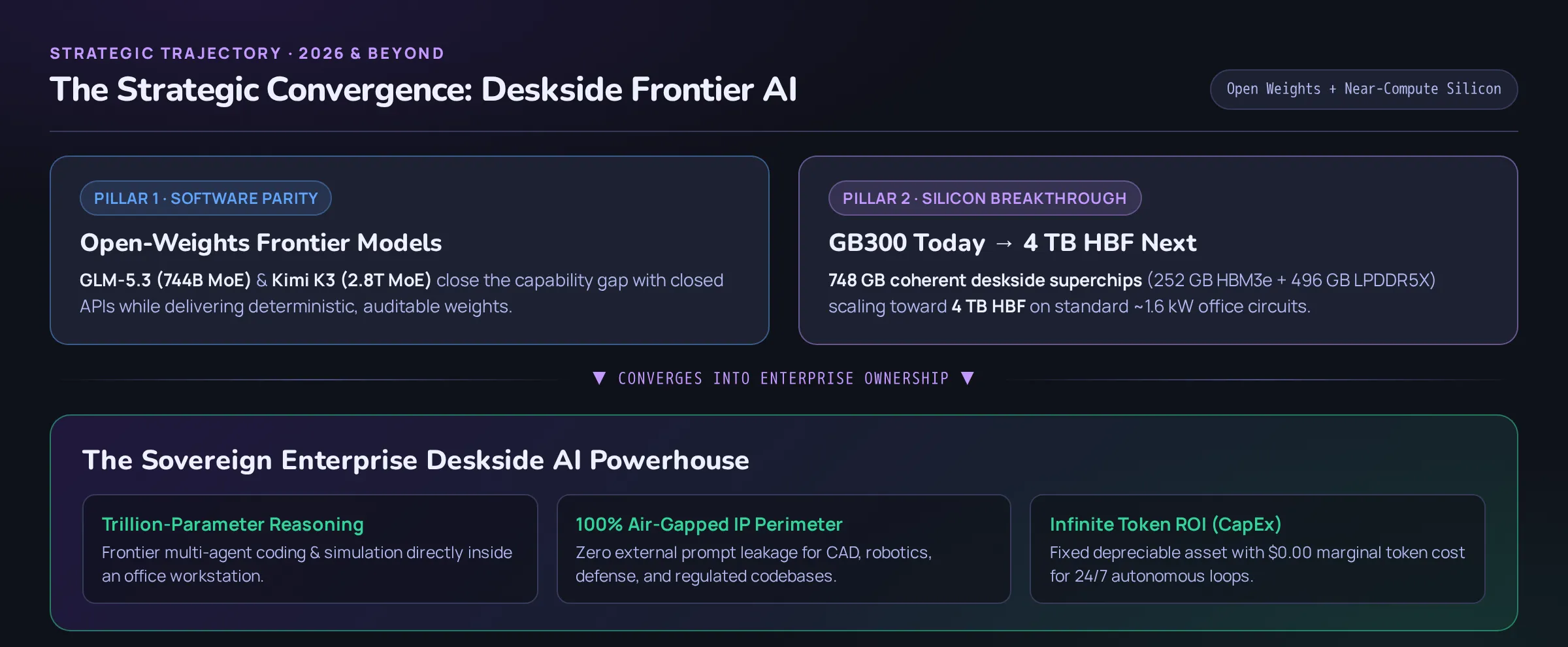
Furthermore, a technological convergence is underway that makes local AI not just an alternative, but the dominant economic and strategic strategy for the next decade. Open-weights models—such as Moonshot AI’s Kimi K3 (2.8 Trillion parameters) and Zhipu AI’s GLM-5.3 (753 Billion parameters)—now match or outperform closed commercial APIs. Concurrently, breakthrough memory architectures like High Bandwidth Flash (HBF)—standardized through the Open Compute Project at up to 512 GB per 3D NAND stack (scaling to 4 Terabytes across an 8-stack accelerator package)—are poised to bring entire multi-trillion-parameter frontier models onto deskside supercomputers like the NVIDIA GB300 / B300 desktop workstation [11], [12], [13], [14].
Here is an executive analysis of why cloud AI subscriptions are an unsustainable operational liability, how local execution works today on standard hardware, and how leadership can capitalize AI as a depreciable asset with infinite token ROI.
The Executive AI Architecture Choice
| Dimension | Cloud Subscription (OpEx) | Sovereign Desktop (CapEx) |
|---|---|---|
| Pricing Structure | Metered API tokens ($2–$10/1M input; $10–$50/1M output [20], [21]) + monthly seats | $0.00 marginal cost per token (unlimited local inference) |
| Financial Predictability | Variable, escalating OpEx; exposed to post-subsidy rate hikes and long-context multipliers | One-time depreciable hardware asset; fixed, predictable CapEx + ~$5,900 3-yr power [26] |
| Data & IP Security | High risk: proprietary code, CAD, and telemetry leave the enterprise perimeter | 100% air-gapped on-premises; zero external network leakage |
| Vendor Viability & Lock-in | Subsidized by loss-making providers; subject to quota throttling and silent model shifts | Permanent corporate asset; deterministic weights with zero platform dependency |
| Hardware Footprint | Third-party hyperscaler remote datacenters | Standard office workstation (~1.6 kW ceiling on a dedicated 20A deskside circuit [15]) |
1. The Subscription Mirage: The Fragile Economics of Cloud AI
Enterprise managers are accustomed to software-as-a-service (SaaS). For tools like Slack, Salesforce, or Microsoft 365, paying a monthly fee per user per month provides predictable access to a stable, profitable service.
Treating generative AI like SaaS is an expensive category error.
The Venture-Subsidized Reality
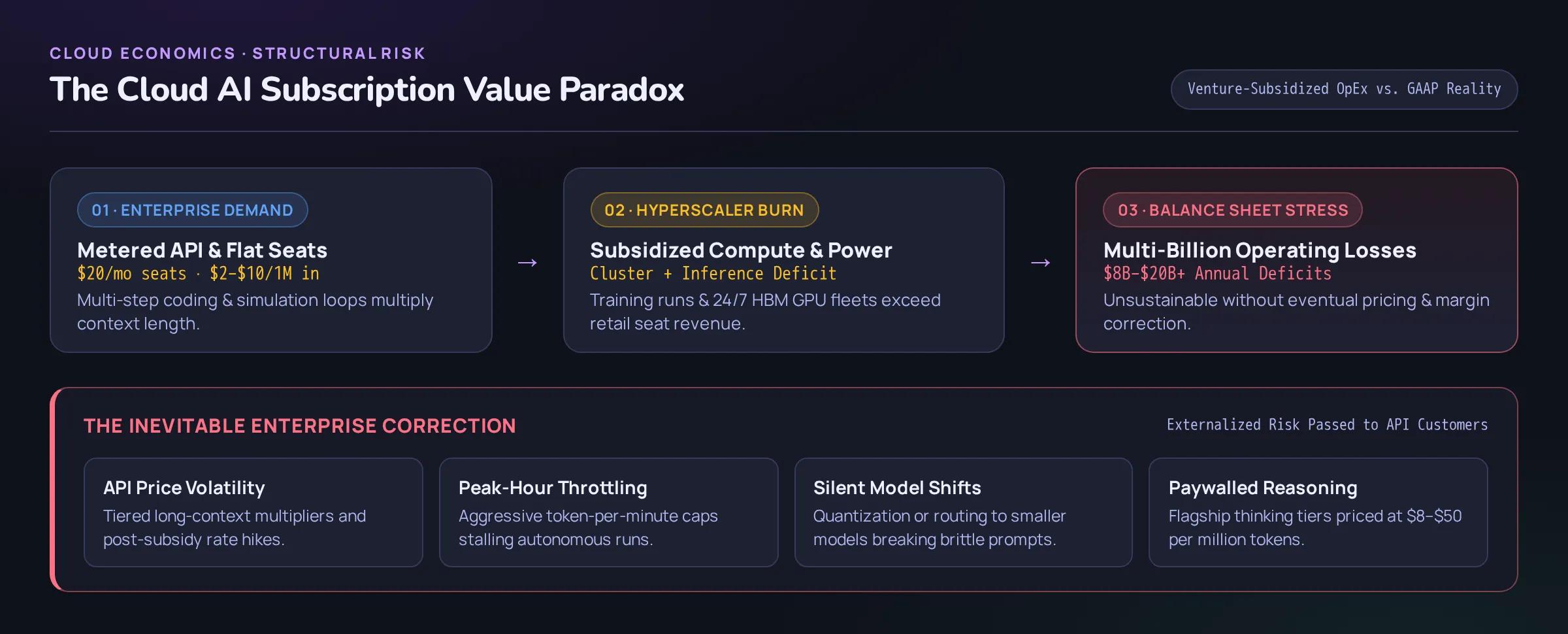
The commercial AI market is currently operating on borrowed time. Industry financial analyses, regulatory filings, and leaked financial prospectuses reveal that the leading frontier AI labs operate at extraordinary financial losses:
- Anthropic generated nearly $4.6 billion in revenue in 2025, but posted an operating loss exceeding $8 billion, alongside more than $518 billion in long-term cloud infrastructure commitments [1], [2].
- OpenAI saw costs and expenses surge past $34 billion against $13 billion in revenue, posting net losses in the tens of billions as compute training and inference bills mounted [3], [4].
To put this in perspective for decision-makers: the $20-per-month flat subscriptions and discounted API token prices that enterprises rely on today are heavily subsidized loss-leaders. Venture capital and hyperscaler cloud balance sheets are footing the remainder of the electric and compute bill [4], [5].
The Unavoidable OpEx Trap
As these companies prepare for public markets or face investor pressure to generate positive GAAP operating margins, that subsidy will evaporate [2], [5]. Standard commercial API rates already price mid-tier coding models (such as GPT-6.1/6.2 Sol or Claude Sonnet 5.5) at $2–$3 per million input tokens and $10–$15 per million output tokens, while flagship reasoning models (such as GPT-6 Astra or Claude Opus 5.5 / Fable 5.2) reach $4–$10 per million input and $20–$50 per million output tokens [20], [21]. Even with prompt caching, when enterprise engineering teams embed cloud endpoints into multi-step agentic workflows—such as continuous software testing, document synthesis, or robotics simulation—the token burn multiplies exponentially:
- Token Compounding: An agent that inspects code, runs terminal commands, audits errors, and verifies outputs across 25–50 multi-step loops per day easily consumes 5 million to 20 million tokens per day.
- Escalating Marginal Costs: Heavy production agentic usage routinely lands between $500–$1,200 per engineer per month on mid-tier models and $1,500–$2,400+ per engineer per month on flagship reasoning tiers—putting a 15-engineer division at $15,000 to $22,500+ per month ($180,000–$270,000/year) before any volume growth or rate increases [20], [21].
- The Uncapped Budget Problem: Unlike traditional IT where compute expenses remain flat, agentic OpEx scales directly with productivity. The more successful your agents are, the more your cloud bill punishes your balance sheet.
The Regulatory & IP Impasse
Beyond costs, cloud AI faces an impenetrable legal wall. In sectors like defense, aerospace, advanced manufacturing, medical robotics, and financial services, enterprise IP cannot legally transit third-party cloud infrastructure. Transmitting proprietary CAD blueprints, factory floor coordinates, or patient-adjacent diagnostic telemetry across a public API violates export controls (such as ITAR), strict enterprise NDAs, and international privacy mandates (GDPR, HIPAA).
If an enterprise cannot run its models on-premises, it cannot deploy AI into its core business assets—leaving frontier capabilities locked out of the most valuable and sensitive sectors of the global economy.
2. The Datacenter Myth: Shattering the $693,000 Hardware Illusion
Why haven’t more companies transitioned to running frontier models in-house? Because hardware vendors and cloud evangelists promoted a persistent myth:
“To run a frontier-grade model (over 300 billion parameters), you must purchase a massive 8-GPU server cluster—such as the NVIDIA DGX B300 Server (8x Blackwell Ultra GPU 288 GB, 2.1 TB usable / 2.3 TB raw HBM3e) [13], [17]—typically ranging from ~$400,000 to $693,000+ with multi-year enterprise support bundles, demanding 14.0 kW to 15.1 kW of datacenter power, 10U of rack space, and dedicated facility cooling.”
For an agile product division, robotics laboratory, or mid-market enterprise, that $400,000–$693,000+ price tag and datacenter infrastructure barrier bring internal AI initiatives to an immediate halt.
Dense Models vs. Mixture-of-Experts (MoE)
The assumption that running a frontier model requires a half-million-dollar server pod is rooted in an outdated paradigm: dense neural networks.
In a traditional dense model, every single parameter in the network is activated for every token generated. If a dense model has 700 billion parameters, all 700 billion weights must reside continuously in high-cost GPU memory and calculate simultaneously.
Modern frontier architectures have shifted to Mixture-of-Experts (MoE). Crucially, MoE models do not activate all weights at once. Instead, the network routes each token through only a small, specialized subset of “expert” pathways while the vast majority of the model remains dormant:
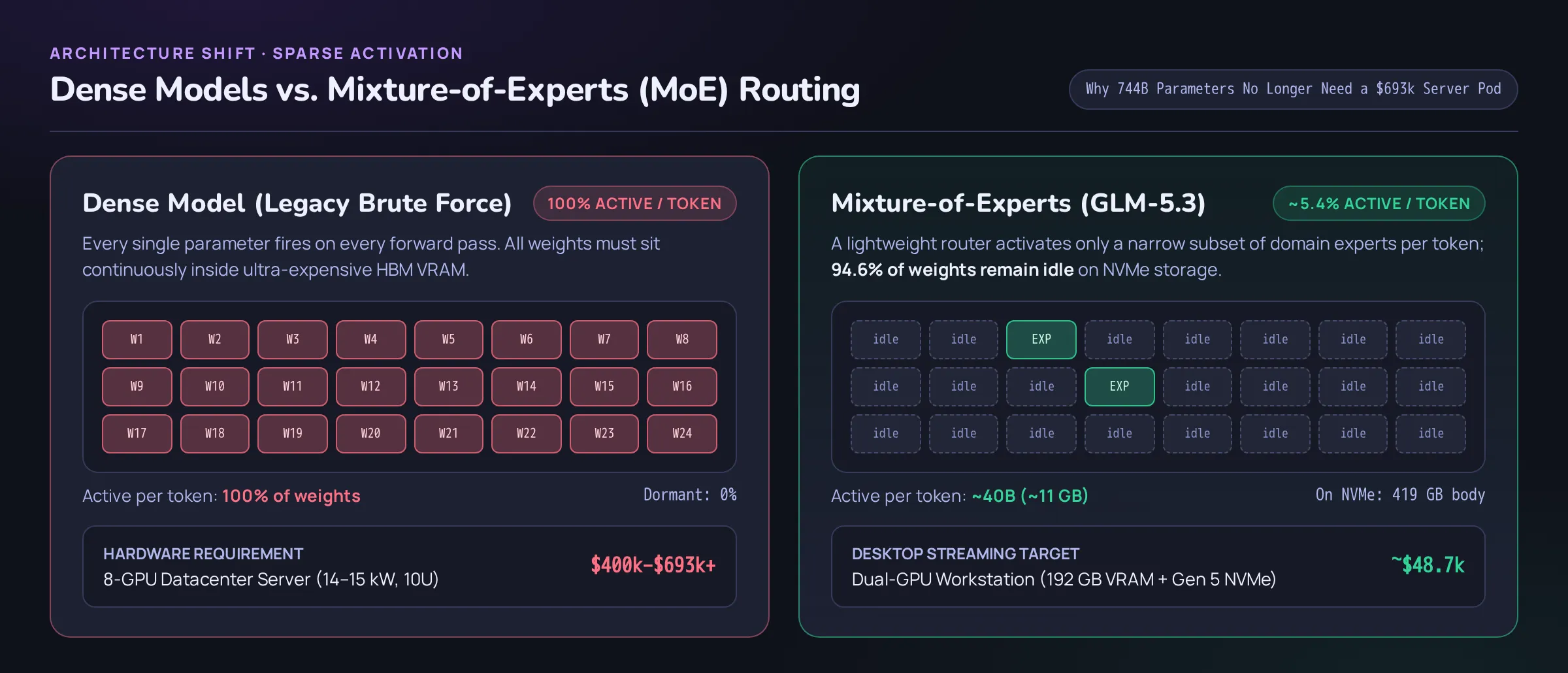
In a state-of-the-art model like GLM-5.3 (744 Billion total parameters), the model is divided into hundreds of specialized “expert” neural networks. While the total model footprint on disk is 419 Gigabytes, only ~40 billion parameters (~5.4% of the model, or about 11 GB of weights) are active when generating any given token [7].
The remaining 94.6% of the network sits idle, waiting for its turn.
The datacenter industry convinced enterprises that they had to pay hundreds of thousands of dollars—up to $693,000 for a bundled NVIDIA DGX B300 rack—to hold all 419 GB inside ultra-fast, ultra-expensive GPU video memory (VRAM) 100% of the time. We asked a simpler engineering question: What if we streamed the experts on demand from high-speed solid-state drives into the GPU only when activated?
3. How We Achieved It Today: The Colibrì Desktop Breakthrough
To eliminate this artificial constraint, we implemented and demonstrated Colibrì—an open-architecture, pure-C streaming inference engine designed specifically to decouple memory capacity from GPU cost [6].
Streaming on Demand vs. Cluster Memory Bloat
In a Mixture-of-Experts architecture, loading an entire 400GB+ model permanently into GPU VRAM is extraordinarily inefficient:
- Severe Hardware Underutilization: Because each token only activates a tiny fraction (~5.4%) of the network, more than 94% of a high-cost GPU cluster’s memory sits completely idle on any given calculation step.
- The Streaming Solution: Instead of purchasing an eight-GPU DGX B300 server just to park dormant weights in expensive VRAM, Colibrì streams the required expert weights on demand directly from high-speed solid-state drives:
- Permanent Attention Core: Foundational attention layers and vocabulary embeddings reside permanently in GPU video memory.
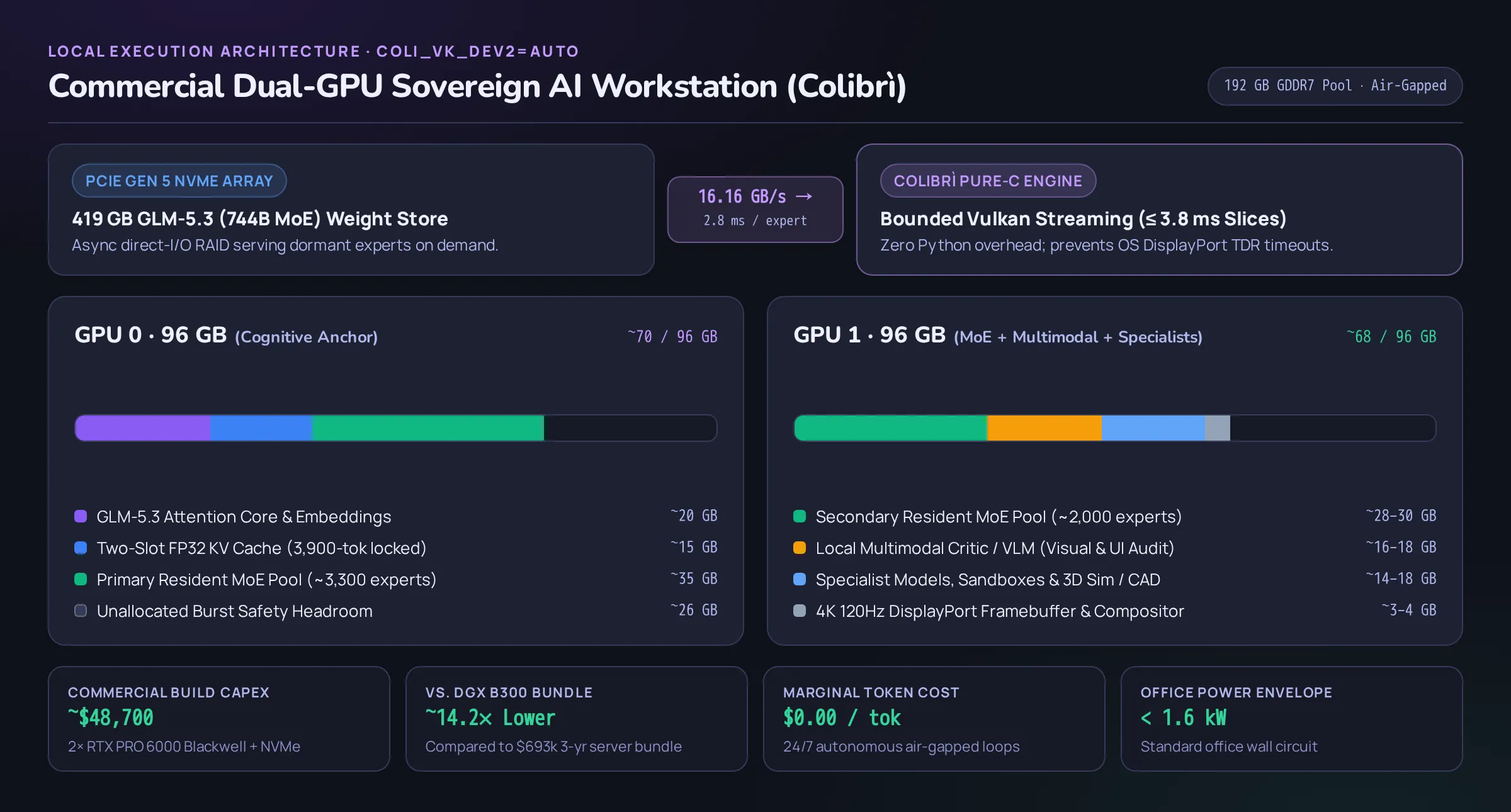
- On-Demand Expert Retrieval: As the model routes through reasoning pathways, Colibrì streams only the active expert weights across standard PCIe Gen 5 NVMe solid-state drives at 16.16 Gigabytes per second, retrieving each expert in just 2.8 milliseconds [6].
- Zero Software Bloat: Built in pure, native C with direct hardware interfaces, Colibrì eliminates heavy Python frameworks, memory leaks, and background operating system overhead.
The Real-World Hardware Reality: Off-the-Shelf Commercial Silicon
Instead of a $400,000–$693,000+ NVIDIA DGX B300 server pod requiring specialized three-phase datacenter power, industrial cooling, and enterprise server colocation [17], this sovereign AI workstation can be built entirely from commercially available, off-the-shelf workstation hardware for roughly $44,000–$50,000 (~$48,700 representative build):
- Dual Commercial GPUs (192 GB Total VRAM Pool): Two NVIDIA RTX PRO 6000 Blackwell Workstation Edition cards (96 GB GDDR7 each)—listed at major U.S. hardware retailers such as Micro Center (~$15,500) [22] and B&H Photo Video (up to ~$17,999) [23], or roughly $31,000–$36,000 for the pair—provide a combined 192 GB memory pool. Crucially, this architecture does not limit a workstation to serving a single monolithic chatbot. Using heterogeneous dual-GPU Vulkan pooling (
COLI_VK_DEV2=auto), Colibrì lets one deskside machine run a 744B frontier reasoning model concurrently alongside multiple specialist local models to execute full multi-agent workflows:- GPU 0 (~70 GB / 96 GB — Cognitive Anchor): Houses the frontier model’s dense attention matrices and token embeddings (~20 GB), a two-slot unquantized FP32 KV cache (~15 GB, permanently locking the agent’s long system prompt), and a primary resident pool of ~3,300 frequently visited MoE experts (~35 GB), leaving ~26 GB of unallocated headroom for burst safety.
- GPU 1 (~65–70 GB / 96 GB — Multimodal & Specialist Co-Processor): Co-hosts the secondary MoE expert pool (~28–30 GB for ~2,000 secondary experts) while simultaneously running the companion models and interactive runtimes that real agentic pipelines demand:
- Local Multimodal Vision-Language Critic (VLM, ~16–18 GB): An AWQ/FP8-quantized vision model (such as
Qwen2.5-VL-7BorGLM-5.3-Flash, ~8 GB weights + ~6–8 GB KV/activation buffers) capable of inspecting screenshots, engineering schematics, UI renders, or multi-camera feeds offline. - Domain-Specific Specialist Models & Execution Runtimes (~14–18 GB): Compact coding/tool-use models, embedding/retrieval indices, CAD/physics simulation engines, or domain-specific neural models running in parallel with the primary planner—all sharing the same zero-latency local bus.
- 4K Desktop Display (~3–4 GB): Driving 4K 120Hz workstation displays smoothly with ~26 GB of unallocated headroom remaining.
- Local Multimodal Vision-Language Critic (VLM, ~16–18 GB): An AWQ/FP8-quantized vision model (such as
- Host Platform & High-Speed PCIe Gen 5 Storage (~$10,000–$13,000): Commercial workstation CPU, ECC DDR5 RAM, high-wattage PSU, and PCIe Gen 5 NVMe solid-state drives configured in an asynchronous direct-I/O array to sustain the 16.16 GB/s streaming throughput and 2.8 ms retrieval latency required by Colibrì.
- Standard Office Power & Footprint: Runs on ordinary desktop hardware drawing under 1.6 kW from a standard office wall circuit, eliminating expensive facility retrofits.
(For organizations with lower initial budgets, entry-tier configurations using dual consumer accelerators like the RTX 5090 or RTX 4090 can lower the hardware investment even further to under $15,000–$18,000).
Most importantly, the machine does not lock up or drop display frames. Because Colibrì carefully bounds its execution slices into small mathematical chunks (COLI_VK_CHAIN_ROWS=128, yielding forward passes), the operating system display compositor and co-resident GPU workloads on GPU 1 are never starved of GPU queue cycles, preventing Windows/Linux DisplayPort TDR (Timeout Detection and Recovery) timeouts [6].
The Performance Nuance: Why the Future Is Exceptionally Promising
To be completely candid about performance: streaming a 744B model over PCIe Gen 5 solid-state drives yields modest token-per-second generation throughput. Because weights must cross the storage bus rather than remaining inside ultra-fast on-die HBM, raw generation speed is small compared to a full datacenter cluster.
However, the objective of streaming today is not to break speed records for human chat; it is to prove a profound architectural shift. This implementation demonstrates that the future of sovereign enterprise AI is exceptionally promising for two fundamental reasons:
- Local Models Are Already at Frontier Parity: We have definitively crossed the capability threshold. Modern open-weights models are already as powerful, articulate, and analytically capable as closed commercial APIs. The intellectual ceiling of local AI has been removed.
- We Are Merely Bottlenecked by Current Memory Technology: The only factor keeping these multi-trillion-parameter models from running at blazing speeds on the desktop is physical GPU memory capacity. And that bottleneck is already being dismantled. Breakthrough semiconductor architectures like High Bandwidth Flash (HBF)—standardized under the Open Compute Project at up to 512 GB per 16-Hi 3D NAND stack—are poised to expand multi-stack single-accelerator memory up to 4 Terabytes (4TB) [11], [12], [14].
Once multi-terabyte near-compute memory arrives, streaming from storage becomes unnecessary: the entire multi-trillion-parameter model will reside directly on local silicon, delivering both frontier intelligence and full datacenter throughput on deskside hardware.
4. Field Proof: Autonomous Robotics Simulation at Zero Marginal Cost
To prove that this dual-GPU Colibrì streaming architecture can power real, end-to-end agentic engineering completely offline, we deployed it on one of the most demanding multi-model workloads in modern automation: Autonomous Physical AI Simulation.
In our benchmark trial (Experiment 01), we combined every piece of the local multi-model stack on a single air-gapped workstation—with no external cloud APIs anywhere in the loop:
- Local Frontier Planning Agent (GPU 0 + GPU 1 via Colibrì): The 744B MoE model streamed from Gen 5 NVMe writes, edits, and debugs simulation code, scene geometry, and physics parameters completely locally.
- Local Multimodal Visual Critic (GPU 1, ~16–18 GB): A local Vision-Language Model (
Qwen2.5-VL-7B/GLM-5.3-Flash) audits rendered overhead and wrist-camera views for non-convex collisions, placement clearances, and physical anomalies. - Headless Physics Simulation & Local VLA Policy (GPU 1, ~14–18 GB): Headless NVIDIA Isaac Sim 6.0 / IsaacLab-Arena (PhysX 5.4 GPU contact solver + 50 Hz multi-camera rendering, ~8–10 GB) runs side by side with a 3-billion-parameter Vision-Language-Action (VLA) model (such as
nvidia/GR00T-N1.6oropenpi, ~6–8 GB) executing continuous robotic manipulation policies.
Building on the reinforcement learning paradigm of Unsupervised Environment Design (UED)—pioneered by Dennis et al. [24] and extended to multi-task generalization by Du et al. at UC Berkeley BAIR [25], where environments are automatically synthesized and adapted rather than hand-crafted—our fully local agentic workflow designed an entire industrial packing-cell environment for a 7-degree-of-freedom Franka Panda robotic arm completely unsupervised. As the local agent iterated through hundreds of physics rollouts, it autonomously caught and repaired subtle physical edge cases as they appeared—such as table chamfer roll-offs and resting-gripper collision explosions—without sending a single byte over the public internet and at $0.00 marginal token cost.
Experiment 01 — Autonomous Robotics Simulation & Verification: Nine parallel Franka Panda manipulation environments synthesized and verified completely offline on a single dual-GPU Colibrì workstation at $0.00 marginal token cost.
(Note: A comprehensive technical breakdown, step-by-step failure post-mortems, and offline telemetry logs from Experiment 01 are being finalized for a dedicated companion case study.)
5. The Horizon Turns Bright: Open Weights Match and Outperform Closed Models
A common objection raised by corporate decision-makers is: “Yes, but aren’t open-weights models vastly inferior to proprietary frontier cloud models like OpenAI’s GPT-6 Astra or Anthropic’s Claude Sonnet 4.6?”
That perception belonged to an earlier era. In 2026, that capability gap has closed.
When evaluating the two premier closed cloud standards for software engineering:
- OpenAI GPT-6 Astra: Sets the proprietary cloud benchmark for complex agentic workflows and repository refactoring, featuring native computer use and a 1M+ token context window [18].
- Anthropic Claude Sonnet 4.6: Delivers state-of-the-art computer use, coding, and long-context planning across a 1M-token context window (beta) with adaptive reasoning depth [19].
Yet frontier open-weights models running directly on local workstations—such as GLM-5.3 (744B MoE) [7] and Kimi K3 (2.8T MoE) [9]—now match these closed models across complex codebases, multi-file refactoring, and agentic tool execution.
When an enterprise chooses an open-weights model, it is no longer making an intellectual compromise. It is choosing a permanent corporate asset:
- Zero Model Degradation: Closed cloud providers continuously update, quantize, and retune their models behind the scenes, frequently breaking fragile enterprise prompts, agentic function signatures, and integration tests without notice. An open-weights model on your workstation executes with mathematical determinism today, tomorrow, and five years from now.
- Full Auditability & Customization: Enterprise engineers can inspect the weights, fine-tune the architecture on confidential internal data, and adapt the system to bespoke domain ontologies without exposing intellectual property or CAD geometries to third-party providers.
- Economics of Scale: Running autonomous multi-agent loops—where thousands of test-and-repair iterations occur overnight—is economically prohibitive on metered APIs like GPT-6 Astra or Claude Sonnet 4.6. On local silicon, marginal token cost is strictly $0.00.
6. The Silicon Revolution: High Bandwidth Flash (HBF) and 4TB on a Single GPU
If open models are scaling into trillions of parameters, a natural question arises: Will local hardware keep pace, or will models inevitably outgrow the desktop?
The answer lies in a transformative memory technology emerging across the semiconductor landscape: High Bandwidth Flash (HBF) [11], [12], [14].
The Memory Wall Problem
In artificial intelligence, the primary hardware bottleneck is not computing speed (arithmetic calculations); it is memory bandwidth and capacity.
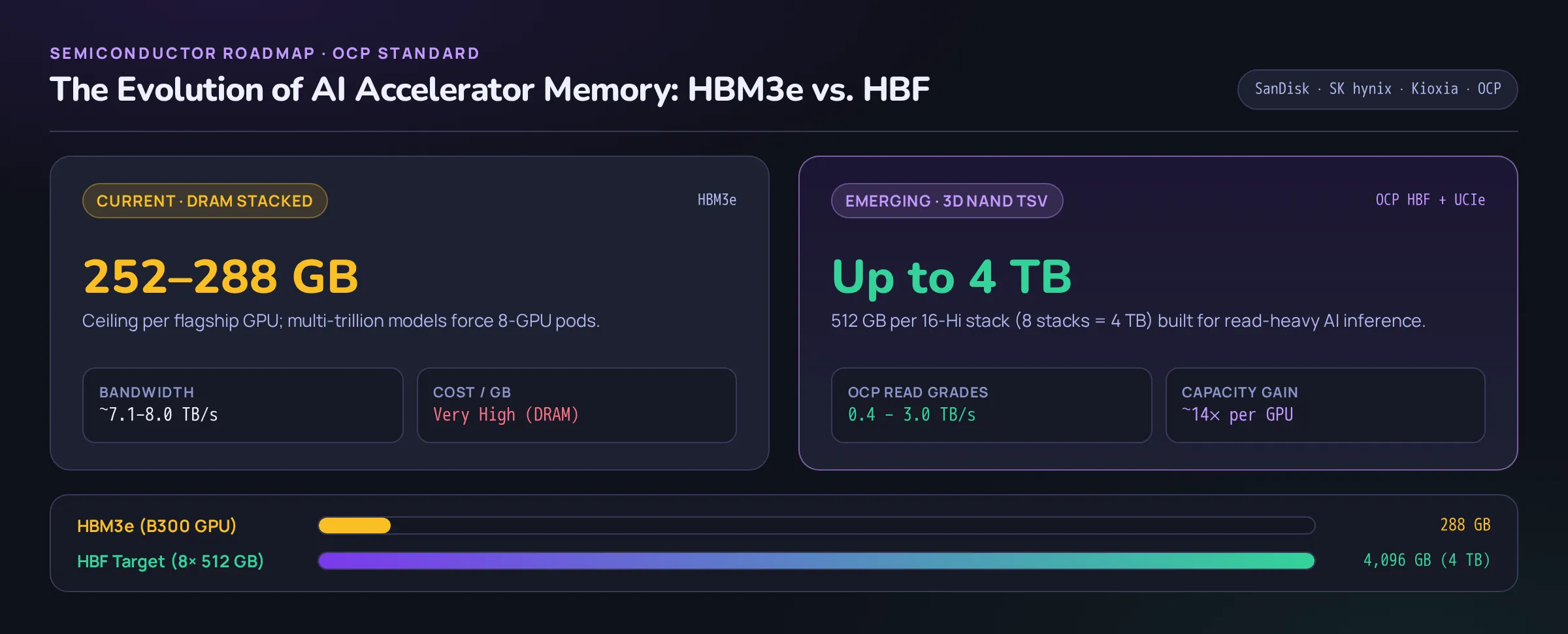
Today’s most powerful AI chips rely on High Bandwidth Memory (HBM3e). HBM is built using ultra-fast dynamic RAM (DRAM). While DRAM offers extreme speed (~7.1–8.0 TB/s per GPU), it is physically constrained in density and prohibitively expensive to manufacture. Flagship datacenter GPUs top out at 288 Gigabytes of raw HBM3e per card (252 GB on desktop GB300) [13].
To hold a 2-trillion-parameter model entirely in DRAM requires chaining multiple massive GPUs together, recreating the high-cost datacenter cluster problem.
The High Bandwidth Flash (HBF) Solution
To solve this “Memory Wall,” memory leaders—led by SanDisk, SK hynix, and Kioxia, and formalized through specifications in the Open Compute Project (OCP)—introduced High Bandwidth Flash (HBF) [11], [12], [14]:
- Stacking Flash Like Memory: Instead of placing flash storage across a distant motherboard cable, HBF stacks dense 8-Hi and 16-Hi 3D NAND flash memory dies vertically via Through-Silicon Vias (TSVs) and attaches them to compute accelerators over the open UCIe (Universal Chiplet Interconnect Express) standard [11], [12].
- Up to 4 Terabytes Across an Accelerator Package: The initial OCP standard specifies up to 512 GB per HBF stack—meaning an 8-stack accelerator package targets 4 Terabytes (4,096 GB) of near-compute memory capacity on a single GPU footprint [11], [14].
- The Perfect Match for AI Inference: Flash memory has traditional write-endurance limits, but AI inference is almost entirely read-only. Once a model’s weights are written to memory, the system reads them billions of times. Across three OCP performance grades spanning 0.4 TB/s to 3.0 TB/s of read bandwidth, HBF delivers the exact memory profile needed for massive model execution at a fraction of HBM’s cost per gigabyte [11], [12].
The Desktop Supercomputer: GB300 / B300 and Beyond
What does multi-terabyte near-compute memory mean for enterprise strategy?
It means that within this hardware generation, an entire multi-trillion-parameter frontier model—such as Moonshot AI’s Kimi K3 (2.8T) or Zhipu AI’s GLM-5.3 (753B)—will be capable of running entirely inside a single accelerator.
This architecture pairs directly with the rise of enterprise deskside supercomputers, exemplified by turnkey commercial systems like the Dell Pro Max with GB300 and the NVIDIA DGX Station / GB300 desktop workstation ecosystem [13], [15], [16]:
- Turnkey Enterprise Power: Systems like the Dell Pro Max with GB300 integrate the NVIDIA GB300 Grace Blackwell Ultra desktop superchip with 748 GB of cache-coherent unified memory (496 GB of LPDDR5X CPU memory + 252 GB of HBM3e GPU memory at ~7.1–8.0 TB/s, linked via 900 GB/s NVLink-C2C), up to 20 PFLOPS FP4 compute, dual 400 Gb/s ConnectX-8 networking, and up to 12–16 TB of NVMe storage in a closed-loop liquid-cooled deskside chassis drawing up to 1,600 W on a dedicated 20A office circuit [13], [15], [16].
- From 252 GB HBM3e to 4 TB HBF: While today’s GB300 workstations already provide 252 GB of HBM3e VRAM plus 496 GB of coherent system memory, the emergence of High Bandwidth Flash (HBF) will expand near-compute weight storage by another order of magnitude—offering upwards of 4 Terabytes (4,096 GB) on-package without network streaming or multi-node cluster partitioning.
- Deskside Autonomy: Rather than renting remote cloud instances across high-latency internet connections, corporate research and engineering teams can place a sovereign intelligence engine directly under an engineer’s desk [13].
7. The Financial Calculus: CapEx Investment vs. OpEx Vulnerability
When evaluating AI investments, Chief Financial Officers and technology executives must compare the lifecycle economics of capitalized hardware assets against variable operational expenses.
Consider a mid-sized engineering division of 15 developers and simulation specialists deploying autonomous agents for continuous code generation, repository analysis, and physical simulation. At verified 2026 commercial API rates, heavy production agentic workloads cost roughly $1,000/developer/month on mid-tier coding models (e.g., Claude Sonnet 5.5 / GPT-6.1 Sol = $15,000/month or $180,000/year) up to $1,500/developer/month on flagship reasoning models (e.g., Claude Opus 5.5 / GPT-6 Astra = $22,500/month or $270,000/year) [20], [21].
Comparing that recurring cloud bill against capitalizing either a Colibrì Dual-GPU Workstation (~$48,700) [22], [23] or a turnkey GB300 Deskside AI Supercomputer (OEM direct starting around $85,000–$105,000, up to ~$139,999 for fully configured 12 TB retail bundles such as the Dell Pro Max GB300 [15], [16])—plus worst-case 24/7 continuous electricity using the U.S. Energy Information Administration (EIA) Table 5.3 commercial sector retail average (~14.01¢/kWh) (1.6 kW × 8,760 h × 3 yr = 42,048 kWh ≈ $5,891) [26]—demonstrates how decisively capital economics favor asset ownership:
Three-Year Total Cost of Ownership (TCO) Comparison (15-Engineer Division)
| Cost Driver | Commercial Cloud API (OpEx) | Colibrì Dual-GPU Workstation (CapEx) | GB300 Deskside Supercomputer (CapEx) |
|---|---|---|---|
| Upfront Hardware & Setup | $0 (zero owned assets) | ~$48,700 (2× RTX PRO 6000 Blackwell + Gen 5 NVMe [22], [23]) | $95,000–$140,000 (OEM direct to fully configured retail [15], [16]) |
| Year 1 Token / Seat Costs | $180,000–$270,000 (15 devs @ $1,000–$1,500/mo [20], [21]) | $0 (unlimited local tokens) | $0 (unlimited local tokens) |
| Years 2 & 3 Recurring Spend | $360,000–$540,000 flat; $470,000–$780,000+ with 20%–35% growth / post-subsidy rate hikes | $0 token fees (hardware fully capitalized) | $0 token fees (hardware fully capitalized) |
| 3-Year Electricity (24/7 Ceiling @ 14.01¢/kWh [26]) | Included in cloud markup | ~$5,900 (1.6 kW continuous max; ~$3.5k–$4.5k typical) | ~$5,900 (1.6 kW continuous max; ~$3.5k–$4.5k typical) |
| Three-Year Total TCO | $540,000–$810,000 flat ($650,000–$1,050,000+ w/ inflation) | ~$54,600 | ~$101,000–$146,000 |
| Net 3-Year Savings vs. Cloud | Baseline (100% OpEx) | $485,000–$995,000+ saved (~10×–19× TCO advantage) | $400,000–$900,000+ saved (~4.5×–7× TCO advantage) |
| Inference Performance | Fast cloud tokens; subject to peak rate limits | Modest NVMe-streamed tok/s (ideal for overnight batch & unsupervised agent loops) | Full native speed (252 GB HBM3e @ ~7.1–8 TB/s + 496 GB coherent [13]) |
| IP & Data Breach Risk | External API perimeter exposure | Zero external exposure (100% air-gapped) | Zero external exposure (100% air-gapped) |
The Psychological Value of “Infinite Token ROI”
Beyond raw cost savings, local execution fundamentally transforms how an organization innovates.
As economic analyses from Andreessen Horowitz (a16z) [27] and empirical developer studies from McKinsey & Company [28] demonstrate, generative AI and autonomous coding agents are driving the marginal cost of producing new software, internal tools, and verification harnesses toward zero. Historically, every custom utility, simulation scenario, or prototype required weeks of scarce engineering labor—forcing companies to gate experimentation tightly and settle for rigid off-the-shelf software. When software generation becomes nearly free and instantaneous, teams can spin up bespoke tools, explore dramatically broader design spaces, and discard unsuccessful prototypes with almost zero sunk cost—compressing the entire business innovation cycle from quarters to days [27], [28].
Yet metered cloud APIs quietly undermine that exact advantage by re-introducing a toll booth on every experiment:
- In a Cloud-Metered Culture: Engineering managers must enforce token budgets, cap multi-agent reasoning iterations, and discourage engineers from running exhaustive overnight sweeps because every extra agent loop hits the monthly credit card. Experimentation is artificially throttled just as code creation becomes cheap.
- In a Sovereign Hardware Culture: The marginal cost of a token is literally zero. Teams can pair near-zero software authoring costs with zero-marginal-cost compute—running continuous 24/7 simulation fuzzing, launching 50-step autonomous verification cycles overnight, and stress-testing every software commit or product hypothesis without asking finance for permission.
Unbounded experimentation creates compounding technical leverage.
8. Strategic Action Plan: How Leadership Should Position Today
Transitioning to sovereign AI does not require an immediate, risky teardown of your current IT infrastructure. Forward-thinking CTOs and engineering directors are executing a four-step phased roadmap:
1. Audit Token Bleed and Shadow AI
Conduct an immediate internal audit of recurring cloud AI expenses. Identify teams spending thousands of dollars monthly on commercial API endpoints and assess the sensitivity of the intellectual property (source code, CAD assemblies, financial records) currently passing through those endpoints.
2. Isolate Data-Sovereignty Red Zones
Classify corporate workflows into public-tier tasks (general market research, drafting non-confidential press releases) and Sovereign Red Zones (proprietary robotics simulation, internal product architecture, trade-secret algorithms). Mandate that Sovereign Red Zones operate strictly on air-gapped or on-premises systems.
3. Pilot Streaming Local Inference on Existing Workstations
You do not need to wait for next-generation hardware to begin. Using streaming architectures like Colibrì, teams can immediately deploy 700B+ models on current dual-GPU workstations. Run pilot programs validating autonomous software repairs, document classification, or unsupervised environment design using open weights like GLM-5.3 or Qwen 2.5.
4. Build Model-Agnostic Scaffolding
Avoid writing software that is hardcoded to proprietary cloud APIs. Structure your internal tools, agents, and prompts around open, standardized interfaces (such as local OpenAI-compatible endpoints or structured Pydantic schemas). When HBF-enabled 4TB accelerators and NVIDIA B300 desktop supercomputers arrive on enterprise price sheets, your organization will be positioned to drop in multi-trillion-parameter models with zero code refactoring.
Conclusion: Own Your Intelligence, Control Your Future
The current era of generative artificial intelligence mirrors one of the most consequential architectural shifts in business history: the transition from 1970s centralized mainframe computing to sovereign personal computers.
In the 1970s, mainframe and timesharing incumbents insisted that serious computing was so complex and capital-intensive that enterprises must forever rent terminal cycles from centralized corporate silos [30]. As Joseph L. Bower and Clayton M. Christensen documented in their landmark Harvard Business Review study of disruptive technology [29], established computer leaders dismissed early desktop microcomputers as underpowered toys incapable of serving high-end enterprise workloads—right up until rapid semiconductor scaling put sovereign computing power directly onto the professional’s desk, reshaping enterprise productivity and displacing centralized timesharing models [29], [30].
Generative AI is executing the exact same migration. The era of renting metered tokens from venture-subsidized cloud providers running at historic financial deficits is a temporary historical anomaly.
Through streaming architectures like Colibrì, frontier open-weights models like Kimi K3 and GLM-5.3, and memory innovations like 4TB High Bandwidth Flash (HBF), the center of gravity in artificial intelligence is shifting back where it belongs: inside your enterprise perimeter, running on your hardware, under your complete control.
In the AI-driven economy, real competitive advantage belongs to leaders who own their intelligence—not those who rent it on a meter.
References
- Fortune Editorial Team (Fortune India, 2026). Anthropic IPO Prospectus: Revenue Jumps 1,050% But Posts $42 Billion Loss, $518 Billion Infrastructure Commitments, and AI Risks. Fortune India Article ↩
- PitchBook Financial Analysis (Morningstar, 2026). Anthropic’s Leaked Financials Reflect Fast Growth, but Not a $2 Trillion Valuation: Unpacking Operating Deficits and Infrastructure Obligations. Morningstar Article ↩1 ↩2
- Leswing, Kif (CNBC, 2024). OpenAI Sees $5 Billion Loss This Year on $3.7 Billion in Revenue. CNBC Report ↩
- Zitron, Ed (Where’s Your Ed At, 2024–2025). Exclusive: OpenAI’s Leaked Financial Documents: Compute Bills, Massive Cash Burn, and Operating Deficits. Where’s Your Ed At Investigation ↩1 ↩2
- Zitron, Ed (Where’s Your Ed At, 2024–2025). The OpenAI Bubble & The Subprime AI Crisis: How Cloud AI Subscriptions Run at Heavily Subsidized Losses. Where’s Your Ed At Analysis ↩1 ↩2
- JustVugg (2026). Colibrì: Pure-C Streaming Mixture-of-Experts Engine for Local Frontier LLM Inference. GitHub Repository: JustVugg/colibri. ↩1 ↩2 ↩3
- GLM-5 Team, Zhipu AI & Tsinghua University (THUDM) (2026). GLM-5: from Vibe Coding to Agentic Engineering. arXiv preprint arXiv:2602.15763. ↩1 ↩2
- Qwen Team (2025). Qwen2.5-Coder: Code Large Language Models for Enterprise Software Engineering. Alibaba Cloud Research. arXiv:2409.12186.
- Moonshot AI (2026). Kimi K3: A 2.8-Trillion Parameter Open-Weights Multimodal Mixture-of-Experts Architecture with Native 1M Context Window. Moonshot Technical Report: Moonshot AI Hub. ↩
- Moonshot AI Team (2026). Kimi K3 Architecture Specifications, Delta Attention & Residuals Repository. GitHub Repository.
- Beeler, Brian (StorageReview, 2026). High Bandwidth Flash Gets Its First Open Spec: 512GB Stacks and Up to 3.0TB/s (Open Compute Project, SanDisk & SK hynix Architecture). StorageReview Analysis. ↩1 ↩2 ↩3 ↩4 ↩5 ↩6 ↩7
- Shilov, Anton (Tom’s Hardware, 2025). SanDisk’s New High Bandwidth Flash Memory Enables 4TB of VRAM on GPUs, Matches HBM Bandwidth at Higher Capacity. Tom’s Hardware Analysis. ↩1 ↩2 ↩3 ↩4 ↩5 ↩6
- NVIDIA Corporation (2026). NVIDIA Blackwell Ultra B300, DGX B300, and DGX Station GB300 Grace Blackwell Desktop Superchip Architecture. NVIDIA Blackwell Overview · NVIDIA DGX Station. ↩1 ↩2 ↩3 ↩4 ↩5 ↩6 ↩7
- TechPowerUp News (2025). SanDisk Develops HBM Killer: High-Bandwidth Flash (HBF) Allows 4 TB of VRAM for AI GPUs. TechPowerUp Report. ↩1 ↩2 ↩3 ↩4 ↩5
- Kennedy, Patrick (ServeTheHome, 2026). Hands-on with NVIDIA GB300 Grace Blackwell Ultra Desktop Workstations: Office-Ready 20-PFLOPS Computing. ServeTheHome Review. ↩1 ↩2 ↩3 ↩4 ↩5
- Dell Technologies & Monitors.com (2026). Dell Pro Max GB300 AI Supercomputer Workstation Specifications (NVIDIA GB300 Grace Blackwell Ultra, 496GB Unified System Memory, 252GB HBM3e GPU Memory, 12TB NVMe). Product Specifications. ↩1 ↩2 ↩3 ↩4
- SMTTR (Standard Matter) (2026). NVIDIA DGX B300 Server - 8x Blackwell Ultra GPU 288 GB (3-Year Business Standard Support, 14.5 kW, 2.3 TB HBM3e Memory). Commercial Product Specifications: SMTTR Enterprise Systems. ↩1 ↩2
- OpenAI (2026). Introducing GPT-6 Astra: Frontier Reasoning and Agentic Coding. OpenAI Research. OpenAI GPT-6 Astra. ↩
- Anthropic (2026). Introducing Claude Sonnet 4.6: Computer Use, Coding, and Long-Context Reasoning. Anthropic Research. Anthropic Claude Sonnet 4.6. ↩
- OpenAI (2026). OpenAI API Pricing (Standard, Cached Input, and Batch Rates). OpenAI API Pricing. ↩1 ↩2 ↩3 ↩4 ↩5
- Anthropic (2026). Claude API Pricing Documentation (Standard, Prompt Caching, and Batch Rates). Anthropic Pricing Docs. ↩1 ↩2 ↩3 ↩4 ↩5
- Micro Center (2026). NVIDIA RTX PRO 6000 Blackwell Workstation Edition Dual-Fan AI & Workstation Graphics Card (OEM) — Commercial Retail Listing. Micro Center Product Page. ↩1 ↩2 ↩3 ↩4
- B&H Photo Video (2026). NVIDIA RTX PRO 6000 Blackwell Workstation Edition Graphics Card (OEM) — Commercial Retail Listing. B&H Product Page. ↩1 ↩2 ↩3 ↩4
- Dennis, M., Jaques, N., Vinitsky, E., Bayen, A., Russell, S., Critch, A., & Levine, S. (NeurIPS, 2020). Emergent Complexity and Zero-shot Transfer via Unsupervised Environment Design. arXiv:2012.02096. ↩
- Du, Y., Abbeel, P., Raileanu, R., & Sukhbaatar, S. (UC Berkeley BAIR Commons, 2022). Unsupervised Environment Design for Multi-task Reinforcement Learning. Berkeley BAIR Commons. ↩
- U.S. Energy Information Administration (EIA, 2026). Electric Power Monthly — Table 5.3: Average Price of Electricity to Ultimate Customers by End-Use Sector (U.S. Commercial Sector Average Retail Price, ¢/kWh). EIA Table 5.3 Data. ↩1 ↩2 ↩3
- Andreessen Horowitz (a16z). The Economic Case for Generative AI and Foundation Models. a16z Analysis. ↩1 ↩2
- McKinsey & Company. Unleashing Developer Productivity with Generative AI. McKinsey Digital Insights. ↩1 ↩2
- Bower, J. L., & Christensen, C. M. (Harvard Business Review, 1995). Disruptive Technologies: Catching the Wave. Harvard Business Review. ↩1 ↩2
- Computer History Museum. Revolution: The First 2000 Years of Computing — Personal Computers & Mainframe Computers. Personal Computers Exhibit · Mainframe Computers Exhibit. ↩1 ↩2